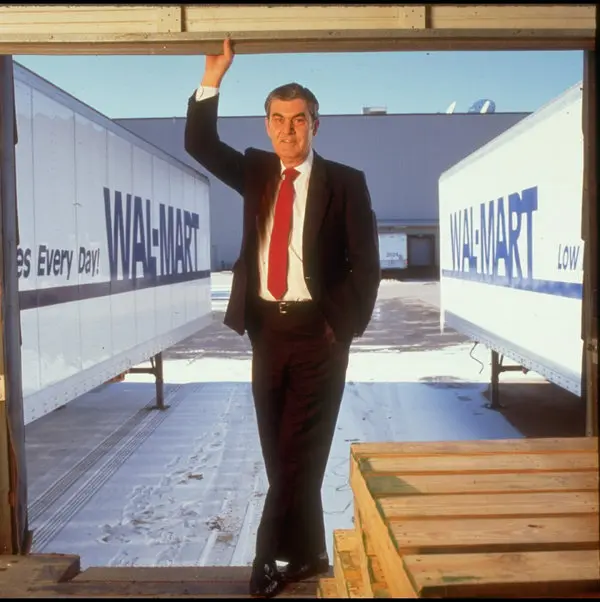
In December 1992, Walmart and CEO David Glass faced criticism after a Dateline NBC investigation challenged the company’s “Buy American” and “Made in America” image. The accusation was broader than a few mislabeled products: Dateline alleged that “Made in the USA” signs appeared above foreign-made goods, that Walmart purchased products from foreign factories using exploited child labor, that the company had shifted business from American manufacturers to overseas suppliers, and that some goods violated import quotas. This made the controversy especially damaging because Walmart’s public identity depended heavily on patriotic sourcing, support for American workers, and trust in store-level merchandising. Glass’s response used several image repair strategies. He relied on denial and defeasibility by questioning whether the images and factory evidence proved what Dateline claimed, and by suggesting that facts such as workers’ ages or factory conditions were either uncertain or simply untrue. Walmart and its suppliers used bolstering by defending the larger “Buy American” program and emphasizing Walmart’s broader support for American manufacturing.
Key Apologia Strategies:
Denial, Defeasibility, Shifting Blame, Bolstering, Good Intentions
Video
N/A
Transcript
Official statement from Walmart:
“Wal-Mart maintains that in the 11 months the company has directly imported from Bangladesh, manufacturers have certified that no illegal child labor has ever been used in manufacturing Wal-Mart merchandise. This was confirmed in a recent surprise visit made by a Wal-Mart executive to the same Bangladesh factory referred to in the NBC story.”
Excerpts from Dateline NBC interviews with Glass:
“We’ve kept sort of a running scoreboard and we’ve converted something over $6 billion worth of merchandise to domestic manufacture that would have been made somewhere else.”
“To my knowledge, we don’t buy from any vendor that uses child labor.”
“It shouldn’t have been signed that way on the rack. That’s…that would be a mistake at a store level.”
“There is no intention in this company to my knowledge ever to deceive anyone. We work for our customers…and we’re trying to represent their interests but do it with total integrity.”
Sources
Benoit, W. L., & Dorries, B. (1996). Dateline NBC’s persuasive attack on Wal-Mart. Communication Quarterly, 44(4), 463–477.
Los Angeles Times. (1992, December 24). Wal-Mart apologizes over “Made in U.S.A.” labels. Los Angeles Times. https://www.latimes.com/archives/la-xpm-1992-12-24-fi-3438-story.html
Seelye, K. Q. (2020, January 21). David Glass, Walmart boss and K.C. Royals owner, dies at 84. The New York Times. https://www.nytimes.com/2020/01/21/business/david-glass-dead.html
United Press International. (1992, December 22). NBC questions Wal-Mart’s “Buy American” campaign. UPI Archives. https://www.upi.com/Archives/1992/12/22/NBC-questions-Wal-Marts-Buy-American-campaign/5209725000400/