Apologia, Kategoria, and Antapologia References

This reference page collects scholarship on apologia, image repair, persuasive attack (kategoria), character assassination, and antapologia. The sections below are organized by topic so that students, teachers, and researchers can more easily locate foundational theory, case studies, and related areas of scholarship.
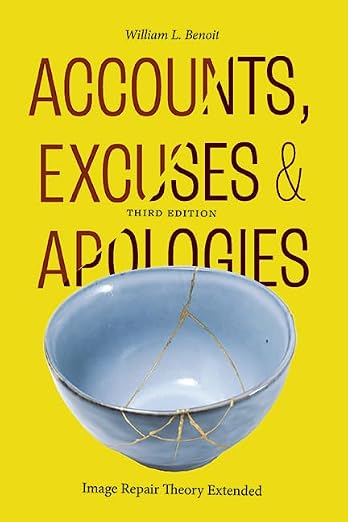
 

Accounts, Excuses, and Apologies book cover
Image source: William L. Benoit

Apologia and Image Repair Studies

Foundational Theory and General Image Repair Scholarship

Abelson, R. P. (1959). Modes of resolution of belief dilemmas. Journal of Conflict Resolution, 3, 343-352.

Alberts, J. K. (1988). An analysis of couples’ conversational complaints. Communication Monographs, 55, 184-197.

Arendt, C., LaFlech, M., & Limperopulos, M. A. (2017). A qualitative meta-analysis of apologia, image repair, and crisis communication: Implications for theory and practice. Public Relations Review, 43(3), 517-526.

Benoit, P. J. (1997). Telling the success story: Acclaiming and disclaiming discourse. State University of New York Press.

Benoit, W. L. (1995). Accounts, excuses, and apologies: A theory of image restoration strategies. State University of New York Press.

Benoit, W. L. (1997). Image restoration discourse and crisis communication. Public Relations Review, 23, 177-186.

Benoit, W. L. (2000). Another visit to the theory of image restoration. Communication Quarterly, 48, 40-44.

Benoit, W. L. (2008). Image restoration theory. International Encyclopedia of Communication. Blackwell.

Benoit, W. L. (2013). Image repair theory. In R. L. Heath (Ed.), Encyclopedia of public relations (2nd ed., Vol. 1, pp. 407-410). Sage.

Benoit, W. L. (2013). Image repair theory and corporate reputation. In C. E. Carroll (Ed.), Handbook of communication and corporate reputation (pp. 213-222). John Wiley & Sons.

Benoit, W. L. (2014). Accounts, excuses, and apologies: A theory of image restoration strategies (2nd ed.). State University of New York Press.

Benoit, W. L. (2014). Image repair theory in the context of strategic communication. In D. Holtzhausen & A. Zerfass (Eds.), The Routledge handbook of strategic communication (pp. 139-147). Routledge.

Benoit, W. L. (2024). Accounts, excuses, and apologies: Image repair theory extended (3rd ed.). SUNY Press. https://doi.org/10.1515/9781438496085

Benoit, W. L., & Drew, S. (1994). Appropriateness and effectiveness of image restoration strategies. Communication Reports, 10, 153-163.

Blaney, J. R., & Alwine, L. (2015). Putting image repair to the test: Quantitative applications of image restoration theory. Lexington Books.

Blaney, J. R., Lippert, L., & Smith, S. J. (2014). Repairing the athlete’s image: Studies in sports image restoration. Lexington Books.

Burke, K. (1962). A rhetoric of motives. University of California Press.

Burke, K. (1970). The rhetoric of religion. University of California Press.

Burns, J. E., & Bruner, M. S. (2000). Revisiting the theory of image restoration strategies. Communication Quarterly, 48, 27-39.

Butler, S. D. (1972). The apologia, 1971 genre. Southern Speech Communication Journal, 36, 281-290.

Clementson, D. E., Zhao, W., & Beatty, M. J. (2024). Atoning vs. evading when caught transgressing: Two multi-theory-based experiments investigating strategies for politicians responding to scandal. Human Communication Research, 50(4), 545-560. https://doi.org/10.1093/hcr/hqae015

Compton, J. (2016). Sorry sorries: Image repair after regretted apologies. Public Relations Review, 42(2), 353-358.

Compton, J. (2017). Image prepare: Image repair, inoculation theory, and anticipated attacks on credibility. The International Journal of the Image, 8(1), 1-9.

Downey, S. D. (1993). The evolution of the rhetorical genre of apologia. Western Journal of Communication, 57, 42-64.

Ferguson, D. P., Wallace, J. D., & Chandler, R. C. (2018). Hierarchical consistency of strategies in image repair theory: PR practitioners’ perceptions of effective and preferred crisis communication strategies. Journal of Public Relations Research, 30(5-6), 251-272.

Fisher, W. R. (1970). A motive view of communication. Quarterly Journal of Speech, 56, 131-139.

Goffman, E. (1967). Interaction ritual. Anchor Books.

Gold, E. R. (1978). Political apologia: The ritual of self-defense. Communication Monographs, 46, 306-316.

Gribas, J., DiSanza, J. R., Hartman, K. L., Carr, D. J., & Legge, N. J. (2021). Exploring the effectiveness of image repair tactics: Comparison of U.S. and Middle Eastern audiences. Communication Research Reports, 38(3), 150-160.

Harrell, J., Ware, B. L., & Linkugel, W. A. (1975). Failure of apology in American politics: Nixon on Watergate. Speech Monographs, 42, 245-261.

Hoover, J. D. (1989). Big boys don’t cry: The values constraint in apologia. Southern Speech Communication Journal, 54, 235-252.

Huxman, S. S., & Bruce, D. B. (1995). Toward a dynamic generic framework of apologia: A case study of Dow Chemical, Vietnam, and the napalm controversy. Communication Studies, 46, 57-72.

Koesten, J., & Rowland, R. C. (2004). The rhetoric of atonement. Communication Studies, 55(1), 68-87.

Kruse, N. W. (1977). Motivational factors in non-denial apologia. Central States Speech Journal, 28, 13-23.

Kruse, N. W. (1981). The scope of apologetic discourse: Establishing generic parameters. Southern Speech Communication Journal, 46, 278-291.

McClearey, K. E. (1983). Audience effects of apologia. Communication Quarterly, 31(1), 12-20.

McLaughlin, M. L., Cody, M. J., & O’Hair, H. D. (1983). The management of failure events: Some contextual determinants of accounting behavior. Human Communication Research, 9, 208-224.

McLaughlin, M. L., Cody, M. J., & Rosenstein, N. E. (1983). Account sequences in conversations between strangers. Communication Monographs, 50, 102-125.

Metts, S., & Cupach, W. R. (1989). Situational influence on the use of remedial strategies in embarrassing predicaments. Communication Monographs, 56, 151-162.

Page, T. G. (2019). Beyond attribution: Building new measures to explain the reputation threat posed by crisis. Public Relations Review, 45, 138-152.

Rosso, J. D. (2022). Denial: How we hide, ignore, and explain away problems. NYU Press.

Ryan, H. R. (1982). Kategoria and apologia: On their rhetorical criticism as a speech set. Quarterly Journal of Speech, 68, 256-261.

Ryan, H. R. (Ed.). (1988). Oratorical encounters: Selected studies and sources of twentieth-century political accusations and apologies. Greenwood.

Schonbach, P. (1990). Account episodes: The management or escalation of conflict. Cambridge University Press.

Scott, M. H., & Lyman, S. M. (1968). Accounts. American Sociological Review, 33, 46-62.

Schlenker, B. R. (1980). Impression management. Brooks/Cole.

Sheldon, C. A., & Sallot, L. M. (2009). Image repair in politics: Testing effects of communication strategy and performance history in a faux pas. Journal of Public Relations Research, 21(1), 25-50.

Sohn, Y. J., & Edwards, H. H. (2018). Strategic ambiguity and crisis apologia: The impact of audiences’ interpretation of mixed messages. International Journal of Strategic Communication, 12(5), 552-570.

Stein, K. A., & Barton, M. H. (2019). “I’m sorry you interpreted my behavior the way you did”: Toward a new understanding of the nuances of mortification. Western Journal of Communication, 83(2), 252-264.

Towner, E. B. (2009). Apologia, image repair, and reconciliation. Communication Yearbook, 33, 430-468.

Ware, B. L., & Linkugel, W. A. (1973). They spoke in defense of themselves: On the generic criticism of apologia. Quarterly Journal of Speech, 59, 273-283.

Political Apologia and Public Scandal

Achter, P. (2000). Narrative, intertextuality, and apologia in contemporary political scandals. Southern Communication Journal, 65, 318-334.

Benoit, W. L. (1982). Richard M. Nixon’s rhetorical strategies in his public statements on Watergate. Southern Speech Communication Journal, 47, 192-211.

Benoit, W. L. (2006). President Bush’s image repair effort on Meet the Press: The complexities of defeasibility. Journal of Applied Communication Research, 34(3), 285-306.

Benoit, W. L. (2006). Image repair in President Bush’s April 2004 news conference. Public Relations Review, 32, 137-143.

Benoit, W. L. (2016). Barack Obama’s 2008 speech on Reverend Wright: Defending self and others. Public Relations Review, 42, 843-848.

Benoit, W. L. (2017). Image repair on the Donald Trump “Access Hollywood” video: “Grab them by the p*ssy.” Communication Studies, 68, 243-259.

Benoit, W. L. (2019). John F. Kennedy’s image repair on “The Catholic Issue” in the 1960 West Virginia presidential primary. American Communication Journal, 21, 1-10.

Benoit, W. L., Gullifor, P., & Panici, D. (1991). Reagan’s discourse on the Iran-Contra affair. Communication Studies, 42, 272-294.

Benoit, W. L., & Anderson, K. K. (1996). Blending politics and entertainment: Dan Quayle versus Murphy Brown. Southern Communication Journal, 62, 73-85.

Benoit, W. L., & McHale, J. P. (1999). Kenneth Starr’s image repair discourse viewed in 20/20. Communication Quarterly, 47, 265-280.

Blair, C. (1984). From All the President’s Men to every man for himself: The strategies of post-Watergate apologia. Central States Speech Journal, 35, 250-260.

Blaney, J. R., & Benoit, W. L. (2001). The Clinton scandals and the politics of image restoration. Praeger.

Compton, J. (2015). Political humor on the radio, image repair, and Gracie Allen’s 1940 presidential campaign. Journal of Radio & Audio Media, 22(2), 255-264.

Compton, J., & Miller, B. (2015). “You lie!” and “I’m sorry.”: Congressman Joe Wilson’s outburst and attempted image repair. Journal of the Speech and Theatre Association of Missouri, 45, 1-17.

Davis, C. B. (2013). An inconvenient vote: Hillary Clinton’s Iraq war image repair debate strategies and their implications for representative democracy. Public Relations Review, 39(4), 315-319.

Kahl, M. (1984). Blind ambition culminates in lost honor: A comparative analysis of John Dean’s apologetic strategies. Central States Speech Journal, 35, 239-250.

Katula, R. A. (1975). The apology of Richard M. Nixon. Today’s Speech, 23, 1-6.

Kennedy, K. A., & Benoit, W. L. (1997). The Newt Gingrich book deal controversy: Self-defense rhetoric. Southern Communication Journal, 63, 197-216.

Kramer, M. R., & Olson, K. M. (2002). The strategic potential of sequencing apologia stases: President Clinton’s self-defense in the Monica Lewinsky scandal. Western Journal of Communication, 66, 347-367.

Lee, R. E., & Barton, M. H. (2003). Clinton’s rhetoric of contrition. In R. E. Denton & R. Holloway (Eds.), Images, scandal and communication strategies of the Clinton presidency (pp. 219-246). Greenwood.

Len-Ríos, M. E., & Benoit, W. L. (2004). Gary Condit’s image repair strategies: Determined denial and differentiation. Public Relations Review, 30, 95-106.

Ling, D. A. (1970). A pentadic analysis of Senator Edward Kennedy’s address to the people of Massachusetts, July 25, 1969. Central States Speech Journal, 21, 81-86.

Liu, B. F. (2008). From aspiring presidential candidate to accidental racist? An analysis of Senator George Allen’s image repair during his 2006 reelection campaign. Public Relations Review, 34, 331-336.

McGuckin, H. E. (1968). A value analysis of Richard Nixon’s 1952 campaign-fund speech. Southern Speech Journal, 33, 259-269.

Mueller, A. G., II. (2004). Affirming denial through preemptive apologia: The case of the Armenian genocide resolution. Western Journal of Communication, 68(1), 24-44.

Newman, R. P. (1970). Under the veneer: Nixon’s Vietnam speech of November 3, 1969. Quarterly Journal of Speech, 56, 168-178.

Rosenfield, L. W. (1968). A case study in speech criticism: The Nixon-Truman analog. Speech Monographs, 35, 435-450.

Shepard, R. (2009). Toward a theory of simulated atonement: A case study of President George W. Bush’s response to the Abu Ghraib torture scandal. Communication Studies, 60(5), 460-475.

Short, B. (1987). Comic book apologia: The “paranoid” rhetoric of Congressman George Hansen. Western Journal of Speech Communication, 51, 189-203.

Simons, H. W. (2000). A dilemma-centered analysis of Clinton’s August 17th apologia: Implications for rhetorical theory. Quarterly Journal of Speech, 86, 438-454.

Smith, C. R. (1995). Dan Quayle on family values. Southern Communication Journal, 60, 152-164.

Smith, J. S. (2017). “Convenience,” “short-circuited,” and October surprise: An analysis of Hillary Clinton’s progressive apologia during the email server scandal. Kentucky Journal of Communication, 36(1), 4-34.

Theye, K. (2008). Shoot, I’m sorry: An examination of narrative functions and effectiveness within Dick Cheney’s hunting accident apologia. Southern Communication Journal, 73(2), 160-177.

Towner, E. B. (2010). A patriotic apologia: The transcendence of the Dixie Chicks. Rhetoric Review, 29(3), 293-309.

Corporate, Organizational, and Institutional Image Repair

Benoit, W. L. (1995). Sears’ repair of its auto service image: Image restoration discourse in the corporate sector. Communication Quarterly, 46, 89-105.

Benoit, W. L., & Brinson, S. L. (1994). AT&T: “Apologies are not enough.” Communication Quarterly, 42, 75-88.

Benoit, W. L., & Czerwinski, A. (1997). A critical analysis of USAir’s image repair discourse. Business Communication Quarterly, 60, 38-58.

Benoit, W. L., & Henson, J. R. (2009). President Bush’s image repair discourse on Hurricane Katrina. Public Relations Review, 35, 40-46.

Benoit, W. L., & Lindsey, J. J. (1987). Argument strategies: Antidote to Tylenol’s poisoned image. Journal of the American Forensic Association, 23, 136-146.

Benson, J. A. (1988). Crisis revisited: An analysis of strategies used by Tylenol in the second tampering episode. Central States Speech Journal, 39, 49-66.

Blaney, J. R., Benoit, W. L., & Brazeal, L. M. (2002). Blowout! Firestone’s image restoration campaign. Public Relations Review, 28, 379-392.

Borden, S. L. (2012). Press apologias: A new paradigm for the new transparency. Journal of Mass Media Ethics, 27(1), 15-30.

Brinson, S. L., & Benoit, W. L. (1996). Dow Corning’s image repair strategies in the breast implant crisis. Communication Quarterly, 44, 29-41.

Compton, J. (2014). Arby’s image repair tactics as a public relations strategy. Public Relations Review, 40, 122-124.

Drumheller, K., & Benoit, W. L. (2004). USS Greeneville collides with Japan’s Ehime Maru: Cultural issues in image repair discourse. Public Relations Review, 30, 177-185.

Griffin-Padgett, D. R., & Allison, D. (2010). Making a case for restorative rhetoric: Mayor Rudolph Giuliani and Mayor Ray Nagin’s response to disaster. Communication Monographs, 77(3), 376-392.

Harlow, W. F., Brantley, B. C., & Harlow, R. M. (2011). BP initial image repair strategies after the Deepwater Horizon spill. Public Relations Review, 37(1), 80-83.

Hearit, K. M. (1995). “Mistakes were made”: Organizations, apologia, and crises of social legitimacy. Communication Studies, 46, 1-17.

Hearit, K. M. (1999). Newsgroups, activist publics, and corporate apologia: The case of Intel and its Pentium chip. Public Relations Review, 25, 291-308.

Hearit, D. B., & Hearit, K. M. (2011). NPR under fire: On the kategoria-based apologia of Juan Williams. Journal of Radio & Audio Media, 18(1), 65-83.

Hindman, E. B. (2005). Jayson Blair, The New York Times, and paradigm repair. Journal of Communication, 55(2), 225-241.

Jerome, A. M., & Rowland, R. C. (2009). The rhetoric of interorganizational conflict: A subgenre of organizational apologia. Western Journal of Communication, 73(4), 395-417.

Kaylor, B. (2010). In the eye of the storm: Image repair discourse of Dan Rather and CBS after the Bush Guard memos story. Southwestern Mass Communication Journal, 26(1), 111-124.

Lauzen, M. M. (2016). Image repair: A case study of Thierry Fremaux and the Cannes Film Festival. Public Relations Review, 42(1), 170-175.

Maehle, N., & Supphellen, M. (2015). Advertising strategies for brand image repair: The effectiveness of advertising alliances. Journal of Marketing Communications, 21(6), 450-462.

Mazer, J. P. (2013). From apologia to farewell: Dan Rather, CBS News, and image restoration following the 60 Minutes “Memogate” scandal. Ohio Communication Journal, 51, 168-184.

Moody, M. (2011). Jon and Kate Plus 8: A case study of social media and image repair tactics. Public Relations Review, 37(4), 405-414.

Riggs, R. (2019). A new season for the Baylor Nation: Image repair and organizational learning. Ohio Communication Journal, 57, 33-46.

Riley, C. (2015). When cows talk: The Happy California Cow campaign as visual apologia. Argumentation & Advocacy, 51(4), 273-289.

Smith, E. (2012). Corporate image and public health: An analysis of the Philip Morris, Kraft, and Nestle websites. Journal of Health Communication, 17, 582-600.

Thomsen, S. R. (2023). “Not the company we thought it was”: Southwest Airlines’ attempt at image repair during its October 2021 flight cancellation. Public Relations Review, 49(2), 102309.

Ulmer, R. R., Seeger, M. W., & Sellnow, T. L. (2007). Post-crisis communication and renewal: Expanding the parameters of post-crisis discourse. Public Relations Review, 33(2), 130-134.

Celebrity, Media, and Entertainment Image Repair

Benoit, W. L. (1997). Hugh Grant’s image restoration discourse: An actor apologizes. Communication Quarterly, 45, 251-268.

Benoit, W. L., & Brinson, S. L. (1999). Queen Elizabeth’s image repair discourse: Insensitive royal or compassionate queen? Public Relations Review, 25(2), 145-156.

Benoit, W. L., & Nill, D. M. (1998). Oliver Stone’s defense of JFK. Communication Quarterly, 46, 127-143.

Compton, J., & Miller, B. (2011). Image repair in late night comedy: Letterman and the Palin joke controversy. Public Relations Review, 37, 415-421.

Furgerson, J. L., & Benoit, W. L. (2013). Limbaugh’s loose lips: Rush Limbaugh’s image repair after the Sandra Fluke controversy. Journal of Radio & Audio Media, 20(2), 273-291.

Holling, M. A., Moon, D. G., & Jackson Nevis, A. (2014). Racist violations and racializing apologia in a post-racism era. Journal of International & Intercultural Communication, 7(4), 260-286.

Kauffman, J. (2012). Hooray for Hollywood? The 2011 Golden Globes and Ricky Gervais’ image repair strategies. Public Relations Review, 38(1), 46-50.

Kauffman, J. (2018). My ego made me do it: The image repair strategies of Brian Williams. Northwest Journal of Communication, 46(1), 87-107.

Kramer, M. R. (2013). Image repair rhetoric and shock radio: Don Imus, Al Sharpton, and the Rutgers women’s basketball team controversy. Journal of Radio & Audio Media, 21(2), 247-257.

Len-Ríos, M. E., Finneman, T., Han, K. J., Bhandari, M., & Perry, E. L. (2015). Image repair campaign strategies addressing race: Paula Deen, social media, and defiance. International Journal of Strategic Communication, 9(2), 148-165.

McGuire, J. (2012). Excellence in broadcasting: Rush Limbaugh and image repair in the Sandra Fluke controversy. Journal of Radio & Audio Media, 19(2), 206-220.

Spencer, L. G., & Kuznekoff, J. H. (2024). The Try Guys try image repair: Apologia in the age of influencers and digital media. Western Journal of Communication, 89(2), 235-253. https://doi.org/10.1080/10570314.2024.2396010

Stein, K. A., Barton, M. H., & Pierson, K. (2021). “It was like I had murdered a baby”: Hollywood filmmakers’ apologia following “bad” films. Ohio Journal of Communication, 59, 17-31.

Sports Image Repair

Barton, M. H., & Turman, P. D. (2003). Image, public speaking, and the John Rocker press conference. Communication Teacher, 17(3), 7-9.

Benoit, W. L. (2018). Roger Goodell’s image repair on the Ray Rice suspension. Relevant Rhetoric, 9, 1-21.

Benoit, W. L., & Hanczor, R. S. (1994). The Tonya Harding controversy: An analysis of image restoration strategies. Communication Quarterly, 42, 120-140.

Brazeal, L. M. (2008). The image repair strategies of Terrell Owens. Public Relations Review, 34(2), 145-150.

Brown, K. A., Dickhaus, J., & Long, M. C. (2012). LeBron James and “The Decision”: An empirical examination of image repair in sports. Journal of Sports Media, 7(1), 149-175.

Compton, J., & Compton, J. L. (2014). College sports, losing seasons, and image repair through open letters to fans. Communication & Sport, 2(4), 345-362.

Compton, J., & Compton, J. L. (2015). Open letters from the National Football League, concussion prevention, and image repair rhetoric. International Journal of Sport Communication, 8(3), 266-275.

Frederick, E. L., Burch, L. M., Sanderson, J., & Hambrick, M. E. (2014). To invest in the invisible: A case study of Manti Te’o’s image repair strategies during the Katie Couric interview. Public Relations Review, 40, 780-788.

Glantz, M. (2010). The Floyd Landis doping scandal: Implications for image repair discourse. Public Relations Review, 36(2), 157-163.

Hoffman, R., Corr, C., Atwater, C., & Fanelli, S. (2025). Loser language: Examining National Basketball Association players’ image-repair strategies following a loss. International Journal of Sport Communication, 18(2), 152-159. https://doi.org/10.1123/ijsc.2025-0002

Kruse, N. W. (1981). Apologia in team sport. Quarterly Journal of Speech, 67, 270-283.

Martin, S., & McHendry, G. F., Jr. (2016). Kaepernick’s stand: Patriotism, protest, and professional sports. Journal of Contemporary Rhetoric, 6(3/4), 88-98.

Nelson, J. (1984). The defense of Billie Jean King. Western Journal of Communication, 48, 92-102.

Ostrowsky, M. K., & Stein, K. A. (2020). “They executed better than we did”: Image repair strategies used by athletes who lost big games. Journal of Sports Media, 15(1), 75-97.

Sheffer, M. L., Schultz, B., & Tubbs, W. (2018). #deflategate. Newspaper Research Journal, 39(1), 69-82.

Shmittel, A., & Hull, K. (2015). “Shit got cray cray #MYBAD”: An examination of the image repair discourse of Richie Incognito during the Miami Dolphins’ bullying scandal. Journal of Sports Media, 10(2), 115-137.

Stein, K. A., Barton, M. H., & Challis, A. T. (2021). “She’s a princess and I’m a pile of crap”: Retroactive apologia and the Tonya Harding Olympic debacle. In J. N. Rosen (Ed.), The circus is in town: Celebrity athletes and the nature of scandal. University Press of Mississippi.

Walsh, J., & McAllister-Spooner, S. M. (2011). Analysis of the image repair discourse in the Michael Phelps controversy. Public Relations Review, 37(2), 157-162.

International and Cross-Cultural Image Repair

Aspriadis, N. (2026). When recovery communication goes wrong: Blame management and apologia for the Tempi train accident in Greece. Corporate Communications: An International Journal, 1-17. https://doi.org/10.1108/CCIJ-10-2025-0317

Edwards, J. A. (2005). Community-focused apologia in international affairs: Japanese Prime Minister Tomiichi Murayama’s apology. Howard Journal of Communication, 16(4), 317-336.

Edwards, J. A. (2008). The mission of healing: Kofi Annan’s failed apology. Atlantic Journal of Communication, 16, 88-104.

Handley, R. L. (2008). Israeli image repair: Recasting the deviant actor to retell the story. Journal of Communication Inquiry, 32(2), 140-154.

Hatch, J. B. (2006). Beyond apologia: Racial reconciliation and apologies for slavery. Western Journal of Communication, 70(3), 186-211.

Kunczik, M. (1997). Images of nations and international public relations. Lawrence Erlbaum.

Peijuan, C., Ting, L. P., & Pang, A. (2009). Managing a nation’s image during crisis: A study of the Chinese government’s image repair efforts in the “Made in China” controversy. Public Relations Review, 35(3), 213-218.

Ruan, W.-Q., Huang, H., Li, Y.-Q., Wang, M.-Y., & Zhou, Y. (2025). How to repair destination image after internal crises? The apology strategies under different information disclosure scenarios. Journal of Vacation Marketing. https://doi.org/10.1177/13567667251332305

Tabak, L., & Avraham, E. (2018). Country image repair strategies during an asymmetrical conflict: An analysis of the Gaza conflict in 2014. International Journal of Strategic Communication, 12(3), 237-251.

Wen, W., Yu, T., & Benoit, W. L. (2012). The failure of “scientific” evidence in Taiwan: A case study of international image repair for American beef. Asian Journal of Communication, 22(2), 121-139.

Zhang, J., & Benoit, W. L. (2004). Message strategies of Saudi Arabia’s image restoration campaign after 9/11. Public Relations Review, 30, 161-167.


Kategoria, Persuasive Attack, and Character Assassination Studies

Foundational Persuasive Attack and Kategoria Theory

Benoit, W. L. (2017). Criticism of actions and character: Strategies for persuasive attack extended. Relevant Rhetoric, 8. http://relevantrhetoric.com/CriticismofActionsandCharacter.pdf

Benoit, W. L., Stein, K. A., & Barton, M. H. (2024). Persuasive attack: Threatening reputations in public discourse. Peter Lang.

Castor, T. (2015). Accusatory discourse. In K. Tracy (Ed.), The international encyclopedia of language and social interaction (pp. 1-5). John Wiley & Sons.

DiSanza, J. R., & Legge, N. J. (2016). The rhetoric of persuasive attack: Continuing the development of a taxonomy of attack strategies and tactics. Relevant Rhetoric, 7. http://www.relevantrhetoric.com/TheRhetoricofPersuasiveAttack.pdf

Macagno, F. (2013). Strategies of character attack. Argumentation, 27, 369-401.

Morris, G. H. (1988). Finding fault. Journal of Language and Social Psychology, 7, 1-25.

Ryan, H. R. (Ed.). (1988). Oratorical encounters: Selected studies and sources of twentieth-century political accusations and apologies. Greenwood.

Ullman, W. R., & Bodaken, E. M. (1975). Inducing resistance to persuasive attack: A test of two strategies of communication. Western Speech Communication, 39, 240-248.

Character Assassination and Reputation Attack

Benoit, W. L. (2020). Character assassination and persuasive attack on CBS’s Face the Nation. In S. A. Samoilenko, M. Icks, J. Keohane, & E. Shiraev (Eds.), Routledge handbook of character assassination and reputation management (pp. 295-306). Routledge.

Benoit, W. L., & Stein, K. A. (2021). Character assassination on Judge Brett Kavanaugh in his 2018 Supreme Court confirmation hearing. Journal of Applied Social Theory, 1(3), 7-30.

Burrows, S. (2020). The character assassination of Marie-Antoinette: Defamation in the age of the French Revolution. In S. A. Samoilenko, M. Icks, J. Keohane, & E. Shiraev (Eds.), Routledge handbook of character assassination and reputation management. Routledge.

Coombs, W. T., & Holladay, S. (2020). Corporate character assassination and crisis communication. In S. A. Samoilenko, M. Icks, J. Keohane, & E. Shiraev (Eds.), Routledge handbook of character assassination and reputation management. Routledge.

Hintz, E. A., Romann, L. R., Tucker, R. V., & Moore, M. J. (2025). Examining character assassination in patient-clinician interactions about chronic pain. Journal of Health Communication. https://doi.org/10.1080/10810730.2025.2546375

Icks, M., & Shiraev, E. (Eds.). (2014). Character assassination throughout the ages. Palgrave Macmillan.

Icks, M., & Shiraev, E. (2014). Introduction. In M. Icks & E. Shiraev (Eds.), Character assassination throughout the ages (pp. 1-13). Palgrave Macmillan.

Icks, M., Keohane, J., Samoilenko, S. A., & Shiraev, E. (2017). Character assassination in theory and practice: 2017 conference report. CARP Research Lab.

Icks, M., Samoilenko, S. A., Keohane, J., & Shiraev, E. (2020). Content and types of character attacks. In S. A. Samoilenko, M. Icks, J. Keohane, & E. Shiraev (Eds.), Routledge handbook of character assassination and reputation management. Routledge.

Icks, M., Samoilenko, S. A., Keohane, J., & Shiraev, E. (2020). Defending against and managing character attacks. In S. A. Samoilenko, M. Icks, J. Keohane, & E. Shiraev (Eds.), Routledge handbook of character assassination and reputation management. Routledge.

Icks, M., Samoilenko, S. A., Keohane, J., & Shiraev, E. (Eds.). (2020). Routledge handbook of character assassination and reputation management. Routledge.

Keohane, J., Icks, M., Shiraev, E., & Samoilenko, S. A. (2025). Character assassination in politics: Gendered and racialized attacks on Kamala Harris. In S. A. Samoilenko & S. Simmons (Eds.), The handbook of social and political conflict. Wiley.

Miskolczy, I., & Gherghina, S. (2025). Making words harmless: Why politicians survive character assassination attacks. The British Journal of Politics and International Relations, 27(1), 199-219. https://doi.org/10.1177/13691481241264980

Moore, M. J., Romann, L. R., Tucker, R. V., & Hintz, E. A. (2025). Character assassination as a communicative phenomenon: A retrospective review of concept development and extensions. Annals of the International Communication Association, 49(3), 205-215. https://doi.org/10.1093/anncom/wlaf010

Samoilenko, S. A. (2021). Character assassination: The sociocultural perspective. Journal of Applied Social Theory, 1(3), 186-205.

Samoilenko, S. A. (2026). The rise of subversive strategic communication. Corporate Communication Review, 2(1), 4-11. https://doi.org/10.63904/ccr.v2i1.33

Samoilenko, S. A., Erzikova, E., Davydov, S., & Laskin, A. (2017). Different media, same messages: Character assassination in the television news during the 2014 Ukrainian crisis. International Communication Research Journal, 52(2), 28-52.

Samoilenko, S. A., Icks, M., & Shiraev, E. (2025). Character assassination. In Elgar encyclopedia of political communication. Edward Elgar.

Political Attack and Campaign Negativity

Archer, A. M. N. (2023). The effects of elite attacks on copartisan media: Evidence from Trump and Fox News. Public Opinion Quarterly, 87(4), 887-910.

Benoit, W. L. (2013). Mudslinging: The nature of attacks in political campaigns. In C. Rountree (Ed.), Venomous speech and other problems in American political discourse (pp. 129-147). Praeger.

Benoit, W. L. (2014). Seeing spots: A functional analysis of presidential television advertisements from 1952-2012 (2nd ed.). Lexington Books.

Benoit, W. L. (2024). Democracy in crisis: Persuasive attack on President Donald Trump in the January 6 Select Committee’s final report. Speaker & Gavel, 60(1), Article 2. https://cornerstone.lib.mnsu.edu/speaker-gavel/vol60/iss1/2

Benoit, W. L., & Glantz, M. (2017). Persuasive attack on Donald Trump in the 2016 Republican primaries. Lexington Books.

Benoit, W. L., & Harthcock, A. (1999). Functions of the great debates: Acclaims, attacks, and defenses in the 1960 presidential debates. Communication Monographs, 66, 341-357.

Benoit, W. L., & Stein, K. A. (2005). A functional analysis of presidential direct mail advertising. Communication Studies, 56(3), 203-225.

Benoit, W. L., Wen, W.-C., & Yu, T.-H. (2007). A functional analysis of 2004 Taiwanese political debates. Asian Journal of Communication, 17(1), 24-39.

Bonest Phillips, J. (2021). Leave the attacking to others: Assessing the effectiveness of candidate-endorsed and independently sourced televised attack ads in the 2016 presidential election. Mass Communication and Society, 24(3), 319-344.

Cho, J. (2015). Attack versus advocacy: Advertising tone that mobilizes. International Journal of Communication, 9, 2563-2582.

Craig, S. C., Rippere, P. S., & Grayson, M. S. (2014). Attack and response in political campaigns: An experimental study in two parts. Political Communication, 31, 647-674.

Dardis, F. E., Shen, F., & Edwards, H. H. (2008). Effects of negative political advertising on individuals’ cynicism and self-efficacy: The impact of ad type and message exposures. Mass Communication & Society, 11, 24-42.

Dinzes, D., Cozzens, M. D., & Manross, G. G. (1994). The role of gender in attack ads: Revisiting negative political advertising. Communication Research Reports, 11(1), 67-75.

Lee, J., & Xu, W. (2018). The more attacks, the more retweets: Trump’s and Clinton’s agenda setting on Twitter. Public Relations Review, 44, 201-213.

Meirick, P. C. (2005). Political knowledge and sponsorship in backlash from party- and candidate-sponsored attacks. Communication Reports, 18(2), 75-84.

Pfau, M., & Burgoon, M. (1989). The efficacy of issue and character attack message strategies in political campaign communication. Communication Reports, 2(2), 53-61.

Pfau, M., & Kenski, H. C. (1990). Attack politics: Strategy and defense. Praeger.

Phipps, E. B., & Montgomery, F. (2022). “Only YOU can prevent this nightmare, America”: Nancy Pelosi as the monstrous-feminine in Donald Trump’s YouTube attacks. Women’s Studies in Communication, 45(3), 316-337.

Roberts, C. (2013). A functional analysis comparison of web-only advertisements and traditional television advertisements from the 2004 and 2008 presidential campaigns. Journalism & Mass Communication Quarterly, 90(1), 23-38.

Sheckels, T. F. (1994). Mikulski vs. Chavez for the senate from Maryland in 1986 and the “rules” for attack politics. Communication Quarterly, 42(3), 311-326. https://doi.org/10.1080/01463379409369937

Solis, J. A., & Sagarzazu, I. (2020). The media smells like sulfur!!! Leaders and verbal attacks against the fourth estate in unconsolidated democracies. Political Communication, 37, 20-40.

Trammell, K. D. (2006). Blog offensive: An exploratory analysis of attacks published on campaign blog posts from a political public relations perspective. Public Relations Review, 32, 402-406.

Wei, R., & Lo, V.-H. (2007). The third-person effects of political attack ads in the 2004 U.S. presidential election. Media Psychology, 9, 367-388.

Media, Humor, Memes, and Ridicule

Barton, M. H., Stein, K. A., & Church, S. (2020). The disruptive power of memes: The carnivalesque and Kevin Spacey’s place in the Weinstein moment. Relevant Rhetoric, 11.

Compton, J. (2019). Late night television comedy, mid-afternoon congressional testimony: Attacks on Stephen Colbert’s House Judiciary Committee appearance. Comedy Studies, 10, 145-153.

Gilbert, C. J. (2020). Argumentum ad carricare as a mode of character attack: Alec Baldwin as Donald Trump on Saturday Night Live. In S. A. Samoilenko, M. Icks, J. Keohane, & E. Shiraev (Eds.), Routledge handbook of character assassination and reputation management. Routledge.

Lichter, S. R., & Farnsworth, S. (2020). Late-night TV humor and the culture of ridicule. In S. A. Samoilenko, M. Icks, J. Keohane, & E. Shiraev (Eds.), Routledge handbook of character assassination and reputation management. Routledge.

Stein, K. A., & Barton, M. H. (2024). “A film about idiots, for idiots, made by idiots”: Persuasive attack on filmmakers and their “bad” movies. Journal of the Communication, Speech, and Theater Association of North Dakota, 36, 41-56.

Taylor, J. R., Stein, K. A., & Barton, M. H. (2023). Say it like you meme it: Looking back on COVID-19 memes as an extension of the news cycle. Northwest Journal of Communication, 50(1).

Corporate, Consumer, and Organizational Attack

Banks, S. P. (2000). Multicultural public relations: A social-interpretive approach. Iowa State University Press.

Benoit, W. L., & Dorries, B. (1996). Dateline NBC‘s persuasive attack on Wal-Mart. Communication Quarterly, 44, 463-477.

Benoit, W. L., & Harthcock, A. (1999). Attacking the tobacco industry: A rhetorical analysis of advertisements by the Campaign for Tobacco-free Kids. Southern Communication Journal, 65, 66-81.

Benoit, W. L., & Stein, K. A. (2009). The pope looks forward as he looks back: An analysis of political cartoons during the Catholic sexual abuse scandal. In J. R. Blaney & J. P. Zompetti (Eds.), The rhetoric of John Paul. Rowman & Littlefield.

Boklan, S., Griffin, D. J., & Goodboy, A. K. (2014). Communicating consumer complaints: Message content and its perceived effectiveness. Communication Quarterly, 62, 357-380.

Garner, J. T. (2012). Making waves at work: Perceived effectiveness and appropriateness of organizational dissent messages. Management Communication Quarterly, 26, 224-240. https://doi.org/10.1177/0893318911431803

Muehling, D. D., Vijayalakshmi, A., & Laczniak, R. N. (2018). The effects of tolerance of negativity on consumers’ responses to comparative attack advertising. Journal of Marketing Communications, 24(7), 703-719. https://doi.org/10.1080/13527266.2016.1216462

Vijayalakshmi, A., Muehling, D. D., & Laczniak, R. N. (2015). An investigation of consumers’ responses to comparative “attack” ads. Journal of Promotion Management, 21, 760-775.

Attack Resistance and Inoculation

Clyne, L., Fellers, M., & Richards, A. S. (2020). Metacognitive inoculation reduces the persuasiveness of sarcastic attack messages. Communication Reports, 33(2), 68-81.

Wong, N. C. H. (2016). “Vaccinations are safe and effective”: Inoculating positive HPV vaccine attitudes against antivaccination attack messages. Communication Reports, 29(3), 127-138.

Public Figures, Sports, and Case-Based Persuasive Attack

Legge, N. J., DiSanza, J. R., Gribas, J., & Shiffler, A. (2012). “He sounded like a vile, disgusting pervert…”: An analysis of persuasive attacks on Rush Limbaugh during the Sandra Fluke controversy. Journal of Radio & Audio Media, 19, 173-205.

Stein, K. A., Barton, M. H., & Paul, N. (2017). 140 characters to say “I hate you”: Melissa Click, racism, and the media circus at Mizzou. Relevant Rhetoric, 8.

Waddle, M., Bull, P., & Böhnke, J. R. (2019). “He is just the nowhere man of British politics”: Personal attacks in Prime Minister’s Questions. Journal of Language and Social Psychology, 38, 61-84. https://doi.org/10.1177/0261927X18767472


Antapologia Studies

Antapologia and Response Discourse

Benoit, W. L., & Stein, K. A. (2024). Representative Marjorie Taylor Greene: Image and kategoria, apologia, antapologia. Speaker & Gavel, 60(1), Article 4. https://cornerstone.lib.mnsu.edu/speaker-gavel/vol60/iss1/4

Harker, J. L. (2018). Flag on the play: A 5-year analysis of the kategoria and apologia that combine to incite journalistic antapologia in sports reporting. Communication & Sport, 6(5), 570-587. https://doi.org/10.1177/2167479517734851

Hoffman, R., Corr, C., & Martin, C. L. L. (2024). A case-study examination of the apologia and antapologia of U.S. track and field athlete Shelby Houlihan. International Journal of Sport Communication, 17(3), 315-324. https://doi.org/10.1123/ijsc.2023-0233

Husselbee, L. P., & Stein, K. A. (2012). Tiger Woods’ apology and newspapers’ responses: A study of journalistic antapologia. Journal of Sports Media, 7, 59-87.

Kramer, M. R. (2013). The image repair media interview as apologia and antapologia: Marion Jones on The Oprah Winfrey Show. In J. R. Blaney, L. R. Lippert, & J. S. Smith (Eds.), Repairing the athlete’s image: Studies in sports image restoration (pp. 59-70). Lexington Books.

Sanderson, J., & Hambrick, M. E. (2016). Riding along with Lance Armstrong: Exploring antapologia in response to athlete adversity. Journal of Sports Media, 11(1), 1-24.

Stein, K. A. (2008). Apologia, antapologia, and the 1960 Soviet U-2 incident. Communication Studies, 59, 19-34.

Stein, K. A. (2010). Jewish antapologia in response to Mel Gibson’s multiple attempts at absolution. Relevant Rhetoric, 1, 1-14.

Stein, K. A., Barton, M. H., Ault, M. K., & Briscoe, J. R. (2013). Apologist-in-Chief?: Newspaper kategoria and antapologia following Barack Obama’s “Global Apology Tour.” Iowa Journal of Communication, 45, 39-63.

Stein, K. A., Barton, M. H., & Turman, P. D. (2013). In the dark at Texas Tech: News coverage involving the image repair discourse of Mike Leach and Adam James. In J. R. Blaney, L. R. Lippert, & J. S. Smith (Eds.), Repairing the athlete’s image (pp. 203-222). Lexington Books.

Stein, K. A., Larson, S., & Grady, L. A. (2007). Antapologia arguments during the Hurricane Katrina disaster. Proceedings of the International Society for the Study of Argumentation.

Turman, P. D., Stein, K. A., & Barton, M. H. (2008). The voice of the fan: Apologia, antapologia, and the 2006 World Cup controversy. In L. W. Hugenberg, P. M. Haridakis, & A. C. Earnhardt (Eds.), Media and mediated sport fans. Oxford University Press.