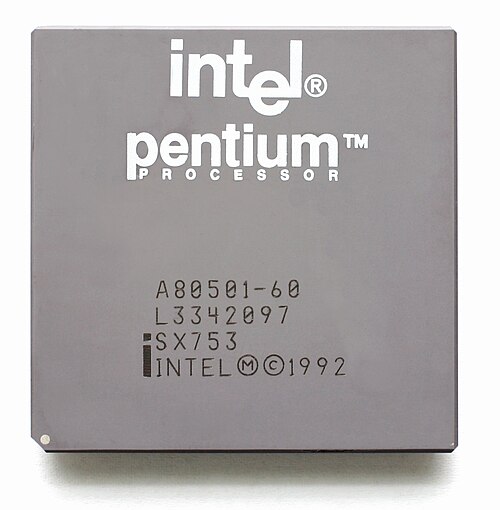
Image Source: Konstantin Lanzet, via Wikimedia Commons
What Was the Accusation?
Intel Corporation faced widespread criticism in late 1994 after a mathematical defect was publicly identified in early Pentium microprocessors. The defect, commonly called the Pentium FDIV bug, affected the processor’s floating-point division operation and could cause certain calculations to return inaccurate results. Mathematics professor Thomas R. Nicely of Lynchburg College encountered unexplained errors while conducting research involving reciprocals of prime numbers. After eliminating other possible causes, Nicely contacted Intel technical support on October 24, 1994, and circulated a public notice on October 30 describing the flaw and providing calculations that other Pentium users could reproduce. Intel’s own engineers had independently discovered the defect months earlier but had not broadly disclosed it because the company considered the likelihood of an ordinary user encountering a consequential error to be extremely small.
The controversy quickly expanded beyond the technical defect itself to Intel’s response to customers. Intel initially defended the Pentium as reliable for ordinary use and estimated that a typical spreadsheet user might encounter the flaw only once in approximately 27,000 years. Rather than replacing every affected processor on request, the company initially evaluated customers individually and provided replacements primarily when it concluded that their work justified one. Critics argued that this policy allowed Intel, rather than the purchaser, to decide what level of mathematical accuracy a customer required. The dispute intensified in December when IBM temporarily stopped shipping Pentium-based personal computers and publicized a much more pessimistic estimate suggesting that some spreadsheet users could encounter an error far more frequently. Specialists disputed both companies’ attempts to translate the flaw into a single universal risk estimate, but IBM’s action greatly increased public attention and pressure on Intel.
On December 20, 1994, Intel reversed its replacement policy. The company announced that any owner of a Pentium-based computer who was concerned about the floating-point flaw could obtain a corrected processor without having to prove a particular need. President and CEO Andrew S. Grove acknowledged that Intel’s earlier policy had appeared “arrogant and uncaring” to some customers and apologized for the way the company had handled the issue. Intel also announced that it would absorb a material charge against fourth-quarter earnings to fund the replacement program. On December 21, Intel published a signed statement from Grove, Executive Vice President and COO Craig R. Barrett, and Chairman Gordon E. Moore apologizing specifically for the company’s handling of the Pentium flaw while continuing to characterize the underlying technical defect as extremely minor. The episode became an influential corporate crisis-communication case because Intel’s eventual corrective action addressed not only a defective product but also public resentment toward the company’s initial effort to define for customers whether the defect mattered to them.
Intel Corporation Public Apology to Pentium Owners and the PC Community (December 21, 1994) — Verified Excerpt:
To owners of Pentium(TM) processor-based computers and the PC community: We at Intel wish to sincerely apologize for our handling of the recently publicized Pentium processor flaw. The Intel Inside(R) symbol means that your computer has a microprocessor second to none in quality and performance. Thousands of Intel employees work very hard to assure that this is true. But no microprocessor is ever perfect. What Intel continues to believe is an extremely minor technical problem has taken on a life of its own. Although Intel firmly stands behind the quality of the current version of the Pentium processor, we recognize that many users have concerns. We want to resolve these concerns. Intel will exchange the current version of the Pentium processor for an updated version in which this floating-point divide flaw is corrected for any owner who requests it, free of charge anytime during the life of their computer. Just call 1-800-628-8686. Sincerely, Andrew S. Grove President & CEO Craig R. Barrett Exec. Vice President & COO Gordon E. Moore Chairman of the BoardSources