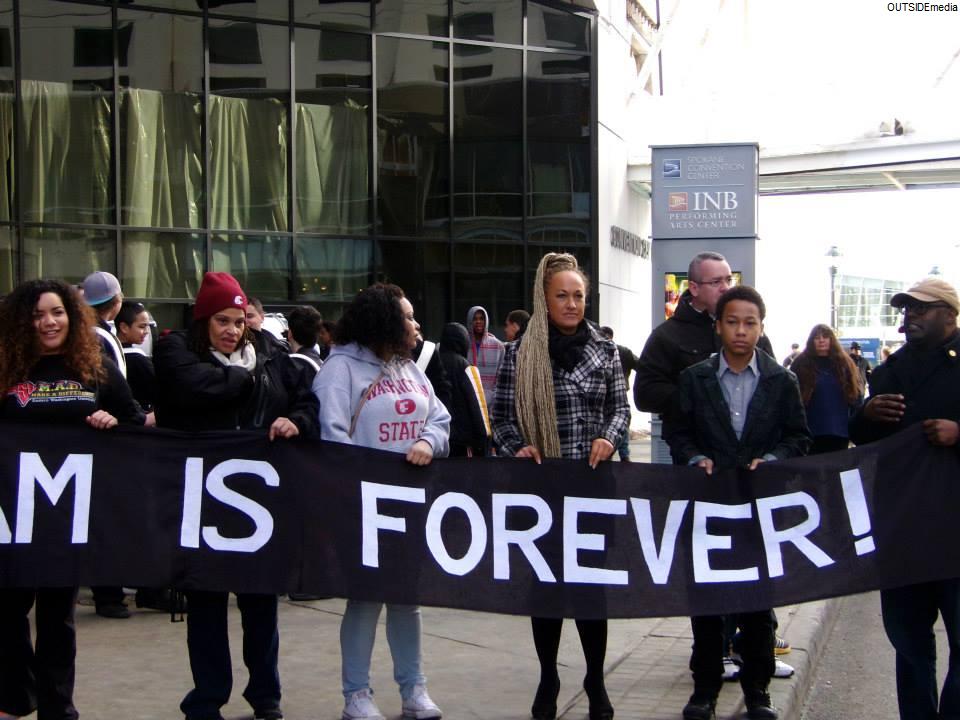
Image Source: Aaron Robert Kathman, CC BY-SA 4.0, via Wikimedia Commons
What was the Accusation?
Rachel Dolezal became the center of a national controversy in June 2015 after questions arose about how she represented her racial identity. Dolezal, then president of the Spokane, Washington, chapter of the NAACP and a civil-rights activist, had been publicly perceived as a Black woman. Her parents, Larry and Ruthanne Dolezal, told reporters that they were white and said their daughter had no known Black ancestry. The controversy intensified after a television reporter asked Dolezal whether she was African American and whether her parents were white; she declined to answer and walked away from the interview.
Critics accused Dolezal of deception and cultural appropriation, arguing that she had allowed people to believe she was biologically Black or biracial. Her previous representations of her background also received scrutiny, including a 2002 lawsuit against Howard University in which she alleged, among other claims, discrimination because she was white. Dolezal rejected the characterization that she was simply impersonating a Black person. She said her identification with Black culture and experience developed over many years and maintained that she genuinely identified as Black.
Dolezal resigned as president of the Spokane NAACP on June 15, 2015. Her resignation statement emphasized her civil-rights work and argued that the controversy over her identity should not distract from the organization’s mission. The following day, she defended herself in an interview with Matt Lauer on NBC’s Today, stating that she identified as Black and disputing accusations that her appearance amounted to blackface.
Dolezal continued defending her racial identity after the initial controversy. In a 2017 interview with The Guardian, she was asked directly whether she believed she had done anything wrong. She said no, argued that she was living authentically, and explicitly rejected apologizing simply to satisfy public demands for contrition. Her response therefore became an unusual apologia in which she defended her identity and actions while refusing mortification for the central conduct under criticism.
Key Apologia Strategies
Denial, Bolstering, Attacking the Accuser, Transcendence
Video
Transcript
Excerpts from Rachel Dolezal’s resignation statement — June 15, 2015:
“I have waited in deference while others expressed their feelings, beliefs, confusions and even conclusions — absent the full story. I am consistently committed to empowering marginalized voices and believe that many individuals have been heard in the last hours and days that would not otherwise have had a platform to weigh in on this important discussion.”
“Additionally, I have always deferred to the state and national NAACP leadership and offer my sincere gratitude for their unwavering support of my leadership through this unexpected firestorm.”
Excerpts from Rachel Dolezal’s Today interview — June 16, 2015:
“I don’t identify as African-American, I identify as black. I am part of the pan-African diaspora.”
“I definitely feel like, in America, even though race is a social construct … there’s still a line drawn in the sand, there still are sides, politically there’s a black side and a white side, and I stand unapologetically on the black side.”
“I really just prefer to be exactly who I am, and black is really the closest race and cultural category that represents the essence of who I am.”
“I also really hope that in some way … it is able to kind of set the record straight because my life story was really warped beyond recognition because of all the negative press in 2015.”
“I really felt like I needed to change my legal name in order to be seen for my qualifications and experience rather than for the tabloid publicity that I got in 2015.”
“It’s still definitely a big challenge, but I’m 100 percent committed to providing for my kids and finding my way back to the activism work that I’m so passionate about.”
Excerpts from Rachel Dolezal’s interview with The Guardian — February 25, 2017:
“I would have these imaginary scenarios in my mind where I was really a princess in Egypt and [my parents] kidnapped and adopted me. I had this thing about just making it through this childhood and then I’ll be OK.”
“I’m trying to regroup, rebuild, remember who I was before the frenzy. People telling me what to think, telling me what to do, telling me to go kill myself. Locally, it feels like I am invisible. People don’t want to associate with me. This great leader that won all these awards no longer exists. It’s just like this disgust, and that was really hurtful, really hurtful.”
“For me, how I feel is more powerful than how I was born. I mean that not in the sense of having some easy way out. This has been a lifelong journey. This is not something that I cash in, cash out, change up, do at a convenience level or to freak people out or to make people happy. If somebody asked me how I identify, I identify as black. Nothing about whiteness describes who I am.”
“I’m sure it’s hard to make sense of for people from the outside, but for me it’s been like a consistent, organic process of coming into who I am. As long as I can remember, I saw myself as black. I was socially conditioned to discard that. It was an all-white town. I was very unhappy. I felt like I was constantly self-sabotaging in order to conform to religion, culture dynamics. I was censoring myself. I was shutting down inside.”
“I don’t think the siblings necessarily changed my identity. I feel it was just an opportunity for me to open up more and it was more acceptable for me to go there, connecting, doing reading and the hair and all these things. It made sense to other people. Oh, your family adopted black siblings. That must be why you identify as black. Not really. The connecting piece for me, when I started to be able to bloom a bit more, was the adoptions gave me a reason to defend reading certain books.”
“It kind of had the two pieces. It had where I wanted to go and where I was coming from. There’s the Christian piece there, because that’s good enough to make the parents feel comfortable with me going there. But it had more than what I had been raised with. It had connection to the black community, it had connection to community development and civil rights work and social justice work. That’s what I really wanted to do.”
On her choosing to braid her hair: “People started responding to me differently. Because it was Mississippi, white girls don’t do that. A lot of people started responding to me as if I was biologically biracial. I kind of let the chips fall where they may.”
“My husband didn’t want me to wear any black hairstyles. Nicole Kidman was his standard of beauty. He was continually: why are you reading black history? Why are you doing this?” “My marriage was like round two of being confined, being told what to do. So when I got divorced, I started returning to myself and returning to styling my hair how I wanted to style my hair and doing other people’s hair as well. That was my personal, I won’t say coming out, but owning who I was. By 2006, I was identifying as black.”
“People were: is she black? Is she white? What is she? What are you mixed with? Usually I’d say my dad is black because to say that neither one is black creates this really long conversation. I don’t know that person. I don’t feel like I owe them that long conversation. They’re going to be looking at me as if I’m crazy.”
On her resignation: “It was really hard. Within 24 hours everything was gone that I had worked for. I lost three-quarters of my friends. I had friends on Facebook sharing my photos with news sources. It got so out of hand, I had to close in really tight, have a small circle. Also to protect my kids. People were sending text messages: ‘Tell your mom to kill herself and do the world a favour.’”
“I was accused of being a liar and a fraud and blackface from the beginning. If that narrative had been handed to me about somebody [else], hell yeah, I’d be upset. I’d be, what is this person doing? It doesn’t sound like somebody who is a good person. It was meant to take me down. It did effectively do that, unfortunately.”
“Other people are operating on an autopilot that race is coded in your DNA, that there are different races of human beings and those races are called black, white, etc. As opposed to race is a fiction that was invented. What I believe about race is that race is not real. It’s not a biological reality. It’s a hierarchical system that was created to leverage power and privilege between different groups of people.”
“I think some people feel that if you question the reality of race you’re questioning racism, you’re saying racism isn’t real. Racism is real because people actually believe race is real. We’d have to really let go of the 500-year-old idea of race as a worldview in order to undo racism.”
“Caitlyn Jenner has not been seen as a woman, and treated as a woman by other people, for her entire life. So what does that mean? What if somebody transitions as a teenager and their entire adult life we know them as a woman. I hope we can reach some kind of term for the plurality of people and allow everybody to be exactly who they are on the spectrum of all these things. Religion, gender, race.”
“I have experienced being treated as a light-skinned black woman or biracial. Cops mark ‘black’ on my traffic tickets. When I applied for a job with a white male leaving, they said Rachel’s a coloured girl. He had a $70,000 salary. The job description was the same, but mine was $36,000. Even in romantic relationships, being exoticised by a white man or seen as the light-skinned black girl by a black man,” she says. “I was not only seen as a mixed chick or a light-skinned black woman, but I was seen as a radical black-power activist type: she teaches black studies at the college, she’s the president of the NAACP, she’s the head of the police accountability commission with all the police brutality issues, she is writing about racial issues.”
“Do we ask women why they airbrush freckles on themselves or why they change their noses? We don’t ask if somebody’s boobs are real or not. I do my hair and my makeup and everything according to how I feel I’m beautiful. Sometimes I use a spray bronzer, sometimes I don’t. Before this happened, nobody was asking me why are you lighter or darker on certain days of the week, depending on how much time I had to get myself together that day; if I had time to give myself a glow. And if I didn’t, I was out the door.”
Again addressing changes to her hair: “Is to copy to compliment or is it cultural appropriation? I think we need to talk about these things in the context of intention, in the context of what is authentic. Is it appropriation to change your genitals? Women have been getting perms – in white culture to get your hair curly, in black culture to get your hair straight – so a perm means altering your hair.”
On accusations that she’s using Blackface: “That was a pretty harsh accusation. I didn’t expect that at all because blackface, you don’t look like a light-skinned black woman, you look like a clown. It’s made to be a mockery. Blackface is not pro-black. Blackface is not working for racial justice. Blackface is not trying to undo white supremacy. I would never make a mockery of the very things I take the most seriously. If I were to have heard all these accusations, or if I would have just read the script as it was without knowing me, as a black-studies professor, yes I would have thought the same. I think it’s just a matter of people being introduced to me through a certain lens that are saying those things.”
“I planned to discuss my past and explain my life and decisions at a much later time, when my kids were all on their own as adults. But the opportunity to speak for myself was gone on 11 June. Maybe I could have told more people that I didn’t want to answer their questions, that my life is a personal matter, and the details of my identity are none of their business, instead of getting backed into corners by trying to answer their questions while protecting our family privacy.”
“I have thought long and hard about it and, given all the specifics of each encounter, I don’t think I would have changed things. I had a purpose before anyone had an opinion about me, and the opinions haven’t changed my life path.”
I wasn’t identifying as black in order to make people happy or make people upset or whatever. I wasn’t seeking fame. I was being me. Of course, it’s affected me in really practical ways of not having a job. It’s really difficult to navigate public spaces. It’s been incredibly hard for my kids. There have been some real experiences, but one of them is not how I identify changing.”