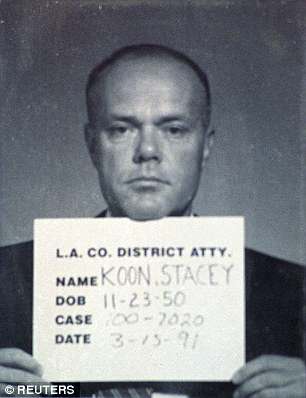
Image Source: Los Angeles District Attorney’s office, Public domain, via Wikimedia Commons
What Was the Accusation?
Los Angeles Police Department Sergeant Stacey Koon faced national scrutiny for his role in the March 3, 1991 beating of Rodney King following a high-speed pursuit through Los Angeles. Koon was the supervising officer at the scene and directed the officers attempting to take King into custody. The confrontation was recorded from a nearby apartment by George Holliday, whose videotape showed officers repeatedly striking King with police batons and kicking him while Koon stood nearby. After the recording was broadcast nationally, Koon and three other LAPD officers—Laurence Powell, Timothy Wind, and Theodore Briseno—were charged in connection with the beating.
Koon maintained that the force used against King had to be understood in the context of what officers encountered before and during the portion of the arrest captured on videotape. He argued that King resisted officers’ efforts to restrain him and that Koon attempted to control the confrontation by directing officers rather than personally administering most of the baton blows visible on the recording. Koon also defended his decision to use a Taser and to authorize officers to use their batons, maintaining that the officers were responding to King’s actions according to their training rather than carrying out a racially motivated assault.
After a California jury acquitted Koon, Powell, and Wind in April 1992 and failed to reach a verdict on one charge against Briseno, Los Angeles erupted in several days of rioting, violence, looting, and arson. Koon continued to defend his conduct while expressing regret about what had happened to King. In subsequent statements and interviews, he rejected the characterization of the incident as a racist beating and argued that the widely viewed videotape did not adequately convey the officers’ perceptions and decisions during the arrest. He also maintained that he had tried to manage an increasingly dangerous situation and believed at the time that the force being used was justified.
Federal prosecutors later charged the officers with violating King’s civil rights. In 1993, a federal jury convicted Koon and Powell while acquitting Wind and Briseno. Koon was sentenced to 30 months in federal prison. His public defense of his actions became an important element of the Rodney King controversy because, as the supervising officer at the scene, Koon was held accountable not simply for force he personally used but for his decisions, commands, and failure to stop force that federal prosecutors argued had become excessive.
Key Apologia Strategies
Attacking the Accuser, Transcendence, Provocation, Defeasibility, Bolstering
Video
N/A
Transcript
Stacey Koon’s Speech to the National Press Club, October 26, 1992:
I don’t know about politicians in Washington, D.C., but politicians in Los Angeles love to complain. They complain about the LAPD. They complain about Daryl Gates. They complain about Mayor Tom Bradley. They complain about District Attorney Ira Reiner. You would think that politicians would stop complaining and be thankful if someone came along and removed the source of their complaints. And I guess that’s the problem here, because that’s what I was trying to do.
I took a few seconds out of my busy doughnut-and-coffee time and I did a little police work in Los Angeles. And as a result, Los Angeles has revamped the Los Angeles Police Department. They’ve got themselves a new chief of police. They’re going to get a new mayor. And they’re going to get a new district attorney. In the course of 82 seconds, Los Angeles was united, and they were the recipients of millions and millions of dollars of federal aid money that Los Angeles never would have had.
You’d think that the person who pulled this off would be praised, that they would bestow honors, but that’s not the case here. Instead, the politicians continue to complain. And what thanks do I get for this? The thanks I get is they want to send me up the river. And if you’ve ever been to Los Angeles and looked at the Los Angeles River, you can understand how unpleasant that would be.
I end up feeling like the Rodney Dangerfield of the Rodney King affair. I just don’t get any respect. And the reason I don’t get any respect is because I embarrassed the politicians in Los Angeles. In the course of 82 seconds, I was able to do more for Los Angeles than every local, state, and federal politician was able to do in 25 years. And even what’s more embarrassing is I did it for free, because they’re not paying me.
Now I ask you, is that public service or what?
Well, good morning. I’m Stacey Koon, Sergeant, Los Angeles Police Department. I was the supervisor on scene for the Rodney King incident. I’ve been on the force for 15 years. Thirteen of those I spent on the street. I have a criminal justice background. I have a bachelor’s degree, a master’s degree, and I have a second master’s degree in public administration from USC. I’ve been married for 21 years. I have five children.
Now I’ve taken off my flak jacket. I’ve put down my police baton. I’ve put on a smoking jacket. I have a typewriter in my hand now, and the result is my book, *Presumed Guilty: The Tragedy of the Rodney King Affair*.
Years ago, I responded to a burglary call. It was a burglary in progress. I got to the call and looked in through the windows of the house. I could see these two suspects moving about inside. As I watched, they carried an Oriental rug from the back bedroom and laid it down in the dining room. One of the suspects ran into the kitchen. He went into a drawer, took out some silverware, ran back to the carpet, turned his back to me, knelt down, and was feverishly stuffing the silverware into the rolled-up carpet.
Well, we ended up catching these two guys. Then we went out to check out the house, and I made an interesting discovery. I discovered that the suspects actually had not carried an Oriental rug from the back bedroom. What I perceived to be an Oriental rug was actually an elderly lady who had on a multicolored robe, which I had misperceived as an Oriental carpet.
Then I made a rather grim discovery, and it’s something I’m never going to forget in my life. What happened is that I misperceived the suspect as stuffing silverware into the carpet. What he had done was take a butcher knife and slit the throat of the elderly woman from ear to ear and nearly decapitated her.
Now, I don’t know if you’ve ever witnessed something like this, but to witness a murder take place before your eyes, not even realize it, and then realize it after it’s too late to do something about it—I mean, as a police officer, I felt—I don’t even know what I felt. It was just a complete failure. And yet all the times I’ve replayed it in my mind—if I had done this, if I had done that—it made no difference.
The point is, I saw what I saw, but my perception of the incident was strikingly different from the stark reality of the situation. I believed what I saw, but I didn’t have complete knowledge. And I relate this story to make this point: What you see isn’t always reality.
And that’s where this Holliday video comes in. What you see isn’t always reality. And that’s exactly what happened.
This incident began on March 3, 1991, about 12:30 in the morning—late Saturday night, early Sunday morning, however you want to look at it. Two California Highway Patrol officers, Melanie and Tim Singer, were on the freeway. Rodney King’s vehicle approached at a high rate of speed. They got off the freeway, got back on the freeway to pace Rodney King’s vehicle, and they accelerated up to 115 miles an hour and could not catch Rodney King.
Finally, Rodney King encountered some traffic and slowed down to about 80 miles an hour. The CHP caught up with him. They flipped on their emergency lights to pull him over, and Rodney King’s reaction was simply to continue driving. Then suddenly, without notice, he cut across three or four lanes of traffic, got off the freeway, and got onto the surface streets of Los Angeles.
He drove for about eight miles. He was running stop signs. He was running red lights. He was going 60 to 80 miles an hour on the surface streets of the city. He was causing a multitude of near accidents.
Now, I don’t know how many times you’ve seen somebody commit a traffic violation and you say, “You know, if I did that, the police would write me up.” If you take this incident and just look at it, that’s exactly what happened. Rodney King—nothing has happened to him. He hasn’t been charged with anything.
Well, let me give you some insight into pursuits. I’ve been in about 50 of them. People who run from the police who are mere motorists—that doesn’t happen. Rather, my experience has been almost 100 percent of the time that the people who run from police are wanted felony suspects. They’ve either killed somebody, they’ve robbed somebody, they’ve burglarized something, they’re in a stolen car. There’s some kind of felony involved and they don’t want to get caught.
They don’t want to get caught. They are highly motivated to take the risk of serious injury to themselves or others in an attempt to escape arrest.
Now, generally there are two kinds of pursuits. The first kind is a kind of “balls-out, we’re just trying to get away.” The second kind is a stop-and-start. And that has a certain significance for police officers because, in the stop-and-start type of pursuit, the police are lured in. And the training a police officer goes by is that when this occurs, the reason you’re being lured in is because they’re going to try to kill you. So officers attach a certain significance to those kinds of pursuits.
And you have to understand what happened in Los Angeles just a few weeks prior, something that was on the mind of every Los Angeles police officer and carried tremendous significance. Officer Tina Pratt, I believe, was the first female officer on the Los Angeles Police Department to be killed in the line of duty.
It had been a simple stop, just nothing. She sat in her car at the computer. She was typing in the location. She didn’t see the suspect approach with a gun until it was too late. As she sat in the car, he executed her. He shot her in the head. She died there.
Now, the thing is, she was a police officer like me. But she was also like you, or like the lady in the back. She was married. She had two kids, like everybody else in this world. There’s this misconception that cops are rubber. They’re not. They bleed and they die just like everybody else in this world.
And that brings us to Rodney King. It’s true that Rodney King was, as the media said, a black motorist. But he was also much more. He was driving with a total disregard for his personal safety, the personal safety of others, the property of others, and for police officers.
We have an obligation to stop him. We have a duty to stop him before he becomes involved in a traffic accident, before he injures or kills somebody else. And from a police officer’s standpoint, the consequence of not doing that, of not arresting the Rodney Kings of this world—it’s—
I’ll give you a little personal example here. Years ago, I worked in Hollywood. My partner and I were waiting for the victim of a GTA—a grand theft auto. Her car had been stolen, and as we waited on the street, another car came screaming off a side street, saw us in our police car, came to a screeching halt, and looked at us. We looked at him.
It was obvious that the driver of the car was probably intoxicated. We had to make a choice: Do we wait here for this victim to report her car stolen and get it into the system, or do we arrest this drunk driver? We opted to wait for the victim of the stolen car.
Well, the victim of the stolen car never showed up. Never showed up. The next call we got was a fatal traffic accident. And we get up there, and whose car is there but the gentleman we had the opportunity to stop.
As is often the case with drunk drivers, he wasn’t hurt. But the two female teenagers he had run head-on into were both dead.
As I looked at those two females, I said something to myself. I promised myself something. And I promised myself that this would never happen again.
I had that promise in mind the night the Rodney King incident happened. It’s never going to happen again.
And if you look at Freddie Helms, who was the driver of the next car that night, he was a passenger in a car. All we did for Freddie Helms that night—we saved him. I lived up to that promise. But three months later, the irony of it was that he was involved in another traffic accident. He was another passenger in a drunk-driving car, and this time he was not as fortunate. He was killed. And all we had done for him was give him three months.
Many people are of the opinion that the police distorted Rodney King’s behavior, that they distorted his driving. That’s just not the case. And the best example of that comes from the district attorney’s own star witness, Bryant Allen. Bryant Allen was the second passenger in the car. He was in the rear back seat.
If you look at Bryant Allen’s testimony at trial, his testimony is this: that he was screaming and yelling at Rodney King to stop, and it was like he was in a trance. He was acting bizarre. He was acting weird.
Bryant Allen testified that he had known Rodney King his entire life, that he had never seen him act like this before. Ever.
This is testimony from the D.A.’s witness. This is not a defense witness. This bizarre, trance-like, weird behavior—never seen him act like this before.
Is Rodney King acting weird, or is Bryant Allen lying? I put to you that Bryant Allen is telling the truth in this case.
Ladies and gentlemen, this is where the stop was finally made. This sets the stage for the final stop here.
When the officers stopped him, they conducted a felony stop. What that means is they were barricaded behind the doors, they had their guns out, and they were ordering Rodney King out of the car.
They ordered Bryant Allen and Freddie Helms out. Bryant Allen and Freddie Helms are black. Both complied. Both were ordered into a felony-prone position, and both were taken into custody without incident.
The officers then returned to get Rodney King out of the car. They finally got Rodney King out of the car. About that time I arrived.
When I get there, I see Rodney King in the vicinity adjacent to the open door, and he’s moving left to right and swaying back and forth. The first thing I really notice about him is that he is massive, muscular. He’s buffed out.
That has a certain significance for police officers because police officers are trained that suspects who work out—ex-cons work out in prison all the time because that’s what cons do in prison. They build these massive upper bodies. So my perception was that he’s huge, intoxicated, and he’s an ex-con. And you know what? Both of those perceptions ended up being true.
The next thing that I notice is that he is sweating. It’s about 50 degrees outside and he’s sweating very heavily. You can see this from the light from the helicopter, from the headlights, and I know this has a certain significance because something’s not right here. Something isn’t right.
As he starts to go into a prone position, he starts to reach out on the ground and starts to pat the ground. It’s kind of like he didn’t know where the ground was. You know, like when you walk into a dark room and start searching for the light switch. He’s reaching on the ground.
And now, because of these observations, I have a strong suspicion that perhaps Rodney King might be under the influence of PCP.
I go back to my car. I arm myself with my Taser, and I return back to the scene.
When I return, Rodney King is on the ground. He’s on all fours, kind of like a football player on the line, kind of like a runner in the blocks.
At this time, Melanie Singer begins to approach with a gun in her hand. This is absolutely wrong, because Rodney King is a felony suspect. Rodney King is unsearched. Rodney King is not under control. She is walking up with her gun in her hand. What she’s going to do is inject deadly force into a situation where it doesn’t need to take place at this time.
I order her back. I tell her we’re not going to do that.
And if you have any doubt as to what would have happened in that situation, when we watch the video in the first two seconds here, I encourage you to pluck Laurence Powell out of the screen and put Melanie Singer in that position with her gun in her hand, and you tell me what’s going to happen.
I’ll tell you what’s going to happen. Either Melanie Singer is going to shoot Rodney King, or Rodney King is going to grab the gun away from Melanie Singer and shoot her, or shoot another officer, or shoot any of the multitude of citizens that were standing around. That’s what’s going to happen.
And for that reason, I order her back.
Then I make a command decision. I command Rodney King to get down on the ground. I command him to do that. He refuses to do it.
He begins to look at me and I look at him. And it’s a bizarre feeling because he’s looking through me. He’s not looking at me; he’s looking through me.
Then I begin to engage in a dialogue with him, ordering him, and all I get is gibberish. It’s not French or English. It’s not Spanish or German. It’s a language that he’s making up himself, and it’s repeated over and over and over.
I waited for LAPD officers. They were coming onto the scene. I didn’t allow them to swarm Rodney King, and I told them that if Rodney King began to resist, they were to back off.
Because when you do a tactical plan, you just don’t do one thing. You have to think a step or two ahead.
I command the officers to swarm Rodney King. By that I mean they’re each going to take a limb and they’re going to force him physically, with their weight, to the ground.
And that’s what they do at my command. Laurence Powell is on the left arm. [Another officer] is on the other arm. They are pulling at his arms as hard as they can, with all their might, and Rodney King’s arms are like steel posts. They will not budge.
Finally, Rodney King goes face-first into the ground. The officers begin to muscle Rodney King’s arms behind his back.
And then something bizarre happens. Rodney King becomes an aggressor. He throws four Los Angeles police officers off his back.
I order the officers away from him.
I think I’ve just seen super strength. I believe that’s what I’ve seen. And that reinforces my idea that Rodney King is under the influence of PCP, because that’s what PCP does: it gives you super strength.
But I’ve prepared for this. I have a tactical plan, since I have a Taser. I order the officers back. They comply.
I order Rodney King down. He refuses. He continues to rise.
I Tase him. Fifty thousand volts of electricity.
To give you an idea what 50,000 volts of electricity does, the Taser Corporation has a training tape. What they do is they Tase a live buffalo, an adult buffalo, and it just falls to its feet helpless. And they go, “That’s what 50,000 volts of electricity does.”
It can drop a buffalo.
It doesn’t drop Rodney King.
Rodney King continues to rise. I shoot him a second time, and once again the Taser does not drop Rodney King.
Now I am 110 percent positive that Rodney King is under the influence of PCP. And I’m that way because my training and my experience has been: when the Taser doesn’t work on a suspect, then the suspect may be under the influence of PCP.
And I want you to know the Taser is working.
Once again, you go back to the star witnesses of the district attorney, Melanie and Tim Singer. And what is their testimony at trial? Their testimony was, “We could see the fluctuations in Rodney King’s face from the voltage. We could see that it was vibrating. We know that the Taser is working.”
He was like a monster in a monster movie, where you shoot him and he continues to come back at you. There’s no stopping him.
That was the behavior of Rodney King.
Now I’m scared, because I think that this man has turned into the Hulk.
And to give you an idea what LAPD training is on PCP suspects: handcuffed suspects go to police cars and rip bolted shotguns that are locked in their holders out of the car and then use the shotguns to execute police officers.
We are trained to believe that when someone is under the influence of PCP, he gets what’s called a death grip. You can break the hand. You can break the arm. But you cannot break the grip.
You think of all this action, all this danger, all the fear, all this procedure that I’ve explained here—and all this lead-in—and it’s never been seen on TV because this is all previous.
The thing that you want to get in mind here is, if you went to the movies today and watched the last 80 seconds of a movie, that’s exactly what they’re going to show you. Well, it doesn’t make any sense not to look at the totality of the situation. To just look at those 80 seconds of it doesn’t make any sense at all.
What I’m going to do here now is play you the George Holliday tape. And I want you to keep in mind that George Holliday filmed this tape from 50 yards away, half a football field away.
This is not my perception. This is not what I saw that night. I was right on top of it.
And the other thing you have to remember about this is that traditionally, three-dimensional vision gives you height, it gives you width, and it gives you depth.
I’ll play the full tape, the 80 seconds. Then I’ll play the slowed-down version, 25 percent, and I’ll comment on that. And then I’m going to show you a segment of Dr. Charles Ward’s 3-D enhancement, the encounter between Laurence Powell and Rodney King.
I’m going to do that to show you that the D.A.’s argument was that Rodney King was running away from the police officers, he was not attacking. And that is disputed by this 3-D enhancement here.
What the media never played before was Rodney King.
Our goal is to keep Rodney King down. We don’t want him getting up again and charging an officer. We don’t want to be—we don’t want him stealing a gun and we don’t want him to be armed with that.
This is Rodney King here. You can see his leg is now on the rise. He’s coming up to his knee. At this point here, he’s going to stand up.
At this point here we have physical contact with Officer Powell. Now watch what happens. When Rodney King hits the ground, he comes up approximately 14 inches here.
This is Rodney King in this position right here. He’s trying to take out Rodney King’s arms. You’re going to be able to see this for a moment.
The important thing is, watch Rodney King. A PR-24 metal baton is like a one-inch piece of galvanized pipe. He comes on the rise right here. It knocks him down. He falls down again.
Once again, this is Rodney King in this position right here. You’ll see Powell. You see Rodney King at an angle here. Here’s Rodney King right here. You can see the space in the pavement right here.
Now watch what happens. He goes down into a prone position, and what happens? He comes back to his haunches. Now they deliver the blow.
Rodney King is not going to go prone. He rolls over, being ordered down. Once again, he’s on the rise again.
Officer Powell hits him in the bicep area of his arm here in an attempt to get him pain compliance, to get him down.
Rodney King tries to get back up to his feet again here. Once again, Powell is striking the upper arm.
You’re going to see Rodney King now with his left arm here in a moment. Here he comes up again. He’s going to bring his arm up and block the baton.
This is in training. If you block the baton, you grab it, because you pull the officer in and take your gun away.
He loses balance. He falls to the ground.
The officers are giving him pain-compliance blows, as trained by LAPD, to get him into the prone position.
Still has his legs, arms up.
Now, at my direction, the baton blows are being struck to the arms and legs. I now order the officers to hit his joints—his wrist, his elbow, his knee.
And that’s exactly what they’re doing here because he was feeling no pain. His entire body was anesthetized to the pain. Now they’re concentrating on the joints.
Once again, he gets into a prone position. They don’t hit him. If he tries to rise again, if he cocks his leg, if he starts to shift his arms up, they’re going to strike him again. And that’s exactly what Powell is doing. He’s concentrating on the angle at this particular point here.
There is a pause that takes place here. The officers strike. They retreat. They order. If he doesn’t comply, then they go back again and strike. If he does comply, then they stop.
Here is what’s called the fulcrum roll. This is something that is trained in the prisons, and what those suspects do is they roll into the officer’s feet, they tie up the officer, the officer falls down, and then the officer’s gun is taken away.
That is what ex-cons do. Cons are taught this in prison. They have videotapes of this. It’s in the tactical books. This is the training of LAPD.
Once again, King is on his side here on the ground. Here is not a dangerous position here. This is even more first-hand. He can see what’s going on here.
We want him on the ground. We don’t know, as far as weapons. As far as we’re concerned, he’s under the influence of PCP.
At this point here, he’s not being struck. We’re going to compliance mode.
At this point, I’m off the screen over here. He’s going to bring this left arm back. It’s the right arm that we cannot see. And your eye goes down. He is watching the hand. That’s what you’re taught.
My belief was that he was reaching for his waistband at that point there. And in order to stop that, Rodney King is struck on the upper shoulder area in an attempt to drive him down.
He does not come down. He comes on the rise again.
There are 33 physical contacts with the baton. They are saying, “Stay down.” And what does Rodney King do? He begins to rise again here, and Powell hits his arm near the waistband, where suspects hide weapons.
Rodney King is like a dolly. He goes down and he comes back up. He goes down and he comes back up.
The frame we’re looking at is frame 2514. This was the frame of contact where the D.A.’s contention was Rodney King was attempting to escape.
Dr. Charles Ward used a modern-day technique, a computer program using geometry, and was able to get exact measurements. This is within six inches of accuracy.
This is Officer Powell. This is Rodney King within a 3-D enhancement.
Clearly, Rodney King was not attempting to escape. He was making an assault. Was it an assault? Yes. What he is doing is an assault on the officer. It is not an attempt to run away.
What you see isn’t always reality. That’s the point I’m trying to make here. And what you see in the little snippets that were on TV, what you read in the magazines, what you read in the papers, is not always the truth.
And what you see on that Holliday video is LAPD policy, procedure, and training.
And that’s the tragedy of this incident: nothing with regard to use of force has changed in Los Angeles so far. So tonight, this evening, we can have another incident like Rodney King, because nothing has changed at all.
I strongly urge you to read *Presumed Guilty: The Tragedy of the Rodney King Affair*. Read this book. Use it as a guide. And in doing so, educate yourself and arm yourself with knowledge. Arm yourself with truth—the two most powerful weapons.
There are a couple of things that you bring in there at the beginning. That’s true. You, in your condition today, if you remember it with a baton, I’d probably just have to show you the baton and you’d do whatever I asked you to do. But imagine being struck here, being struck here, being struck on your knees and not feeling it.
This is indisputable, because when he’s brought to the hospital within an hour of this incident, you expect tremendous injuries on him when you watch the tape.
You take a one-inch piece of galvanized pipe and I’m striking you, John. What kind of injuries are you going to have? Probably pretty severe.
You look at him—he got beat bad, didn’t he?
But when he goes to the hospital, the medical doctor’s diagnosis—he has two diagnoses. PCP overdose is number one. That’s in the back of the book here. The document is there.
The second diagnosis is superficial lacerations. That is the extent of Rodney King’s injuries.
He is not feeling pain. No pain. No pain.
He doesn’t feel pain still six hours later when he’s at County-USC and he says, “Oh, you know, I have a little tenderness on my face here.” He has a broken cheekbone, not the result of a police baton but the result of his landing on his face from when he first made contact with Officer Powell.
“And on my right leg I have a little tenderness down here too,” and they X-ray that, and he has a spiderweb-like break. Honestly, a minor, minor break.
That is the extent of Rodney King’s injuries.
You look at that tape—my God, he got beat. Think what you’d look like if I took a one-inch piece of galvanized pipe and hit you. You’re not going to have those injuries.
That is what PCP does.
As far as the officers’ actions, when you get in a stressful situation, you are trained in Los Angeles, and you are trained keenly well, and you are trained to go back to your training in stressful situations.
And that’s exactly what the officers do. That’s why you have this classic pause, because three, four, five times they go back. They order verbal compliance. Nobody strikes, nobody gives.
If he starts to rise again, they go back. Three, four, five times they go back, back and forth.
It isn’t, as the congressman said, 56 times in a few seconds. It didn’t happen that way.
LAPD and CHP had different authorities. The CHP are mainly what they call in Southern California “AAA with a badge.” They mainly just deal with traffic violations. They mainly are just dealing with drunk drivers, and they write tickets.
They do not get involved in these tactical situations like street officers. They’re trained in this, but the training is not standardized in California.
In fact, Melanie Singer’s approach with that gun, according to the CHP manual on tactics, is perfectly okay. It would never be okay in LAPD. It is just too dangerous. LAPD has its training. It has a standard.
So what you’re dealing with here are two different mentalities.
She’s right from her standpoint. She’s wrong from my standpoint.
The point I make is, you take Laurence Powell out of that and you put Melanie Singer there with a gun, and you know what can happen. I know what’s going to happen.
What we’re trying to do here is avoid deadly force. That’s what we’re trying to do. And we came that close to using deadly force in this situation.
And I’ll tell you right now, if I wasn’t there that night, there’s no doubt in my mind right now that one of the officers would have been shot.
Being sarcastic.
That’s particularly the mentality, and it goes right to the riots in this case here. Because the mentality that was setting the stage was set by Daryl Gates early on. It was set March 8th when he gives his “I want a head to roll a day” speech, where he mandates that everybody in LAPD is going to get into lockstep. We’re all going to be against these officers.
And [the lieutenant] knows what the program is. You know, if you want to promote, if you don’t want to be working in Harbor rather than the San Fernando Valley, you’re going to do what you have to do.
We were in anticipation that he would try to hang us on the job.
You promote on LAPD not from the street. That’s one of the things the Webster Commission wanted changed. They wanted police officers to get into command positions that make decisions.
The way it is now in LAPD is you work your way through the staff jobs inside. You never work on the street, and then you have to come back out to the street to manage it before you get the next job.
But you don’t know what you’re doing. He’s new. He’s only been on the job three days. He’s been off the street for 12, 15 years. He doesn’t have the vaguest idea what we’re doing.
If I could relive this whole thing, I would change the use-of-force policy in Los Angeles.
The Los Angeles Police Department has done all the artwork. They’ve put all these drapes up. They’re painting the rooms. But they haven’t changed the issue in this case.
And the issue in this case is use of force. It hasn’t changed in the City of Los Angeles one iota.
They need a bigger menu. They need more tools. They need to downgrade the chokehold from deadly force to just below deadly force, and they have to have that as an option.
That’s what needs to be changed. That absolutely has to be changed so that you have the whole picture.
What happened was, in ’82, someplace in there, the department had this big squabble about use of the chokehold. It used to be used all the time. They upgraded it to deadly force.
Well, what happened? That created a hole in the use-of-force policy.
This policy has been in existence for over 10 years, and this policy has resulted in a tremendous increase in suspect injuries. There was a study published on January 4, 1994. The study says there is a 181 percent increase in suspect injuries and a 395 percent increase in officer injuries as a result of the use-of-force policy.
They encouraged the Police Commission, encouraged the mayor, encouraged the city attorney, encouraged the City Council to change this policy. They take the stand and say, “We cannot be doing this with this long. It is wrong.”
But the black community and the mayor and the Police Commission and City Council and the city attorney, who happened to be Ira Reiner at the time—the district attorney in this case—they all said, “No, no, no, no.”
You look at what a black councilman said in Los Angeles: “Beat my black brother with a baton, but don’t choke him.”
And that’s exactly what the Los Angeles Police Department has been doing for 10 years. They’ve been beating not only blacks and Hispanics, but whites and everybody else, with batons for 10 years.
And now these politicians are in a higher position. Ira Reiner, the mayor—of course, he’s out of the loop now—the council people, several of them: what do they want? They want us to expose the fact that for 10 years they’ve allowed minorities—because by and large minorities are the people who get arrested—
In 1980, we were only arresting 200,000. In 1990, we arrested 300,000. An increase.
More and more minorities are being beaten.
And it’s been at the approval of the Police Commission. It’s been at the approval of the mayor. It’s been at the approval of the City Council. It’s been at the approval of the city attorney and the policymakers.
Their own team came in and said, “Don’t do this.” They said, “Too bad.”
If the carotid chokehold had been there, they would have been able to immediately restrain Rodney King in 10 to 15 seconds.
On the first blow, there wouldn’t have been one baton blow. With a carotid chokehold, Rodney King would have been choked out. He would have passed out and been cuffed and hog-tied by the time he woke up. It would have been over.
It would have been that fast.
But that kind of thing doesn’t work on PCP, and that’s what you train to do.
That turns out—that he wasn’t abusing PCP—that’s wrong.
And you look at the doctor’s diagnosis in the back of the book. There is a finding, there is evidence right in the back of the book to support what we’re saying here, that this isn’t some concocted story that I’ve made up here.
You look on page 254, Appendix N. You look at the diagnosis of the doctor: PCP overdose; facial lacerations, superficial.
That is the doctor’s diagnosis within an hour of this incident.
You look down here on his condition. You have good, fair, serious, critical, or deceased.
What is it? Fair.
You look at how he walked out of the hospital. He walked out of the hospital.
You tell me that you or I get beat like we’ve been describing on this stage, and I’m not going to be in serious condition? I’m not going to be in critical condition?
You know, they want to make this analogy that Reginald Denny got the same thing Rodney King did.
Reginald Denny got hit in the head. You can see that on the tape. Reginald Denny was in critical condition and almost died.
Rodney King walked out of the hospital.
Reginald Denny didn’t walk out of the hospital. Several weeks later, he was left in a wheelchair.
These are not the same kind of injuries. Not at all.
As far as the PCP, it’s true the urine test showed negative. If you read the book, you look at what Dr. Generosa, the County-L.A. doctor who examined him six hours later, said: the test is inconclusive because Rodney King has a high alkaline level in his body. That would have negated the test.
There are only a few tests that will show whether or not Rodney King had PCP, and that is a protein sample from hair or a tissue sample. Both of these tests Rodney King had refused to submit to.
And I put to you that the reason Rodney King refused to submit to them is because if he had submitted to them, it’s going to indicate that he had been using PCP.
PCP is one of those substances that when you take it, it gets into your fat. And when you’re in a stress situation, it breaks down. That’s what they call a flashback. It goes into your system and then out immediately.
So blood and urine tests aren’t going to track this. That’s why you need a tissue sample. That’s why you need a protein sample.