Oliver Stone
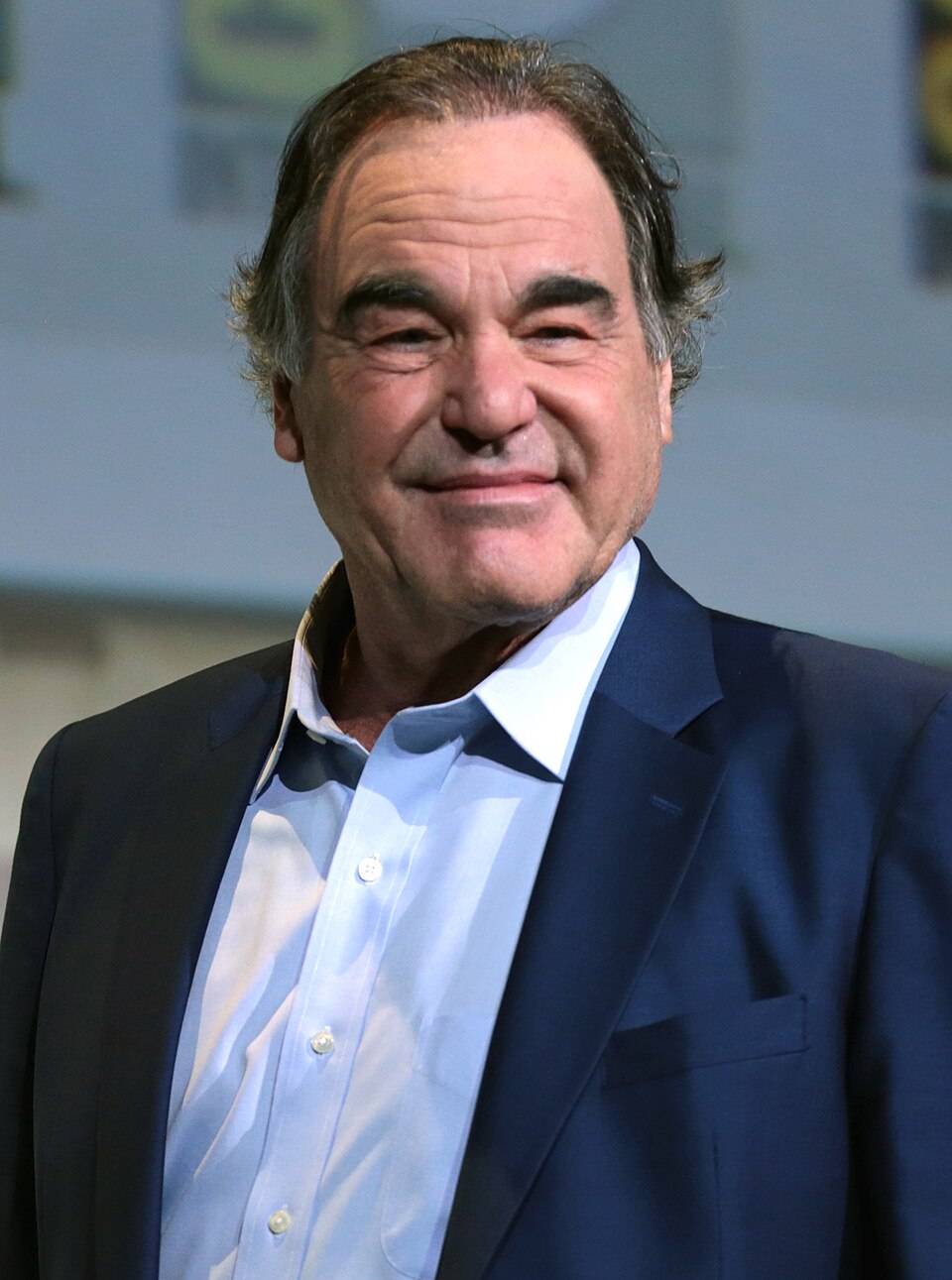
Image Source: Gage Skidmore, CC BY-SA 3.0, via Wikimedia Commons
What Was the Accusation?
Filmmaker Oliver Stone faced intense criticism in 1991 over JFK, his dramatization of New Orleans District Attorney Jim Garrison’s investigation into the assassination of President John F. Kennedy. Even before the film reached theaters, journalists, historians, former Warren Commission personnel, and other critics accused Stone of blurring documented history with speculation, relying on disputed sources, rehabilitating Garrison’s controversial investigation of New Orleans businessman Clay Shaw, and presenting an elaborate conspiracy theory in a form that audiences might mistake for established historical fact. The controversy became unusually heated because Stone combined authentic archival material with dramatized and speculative scenes while challenging the Warren Commission’s conclusion that Lee Harvey Oswald acted alone.
The criticism began months before the film’s December 1991 release. In May, The Washington Post published an article by reporter George Lardner Jr. criticizing an early screenplay and questioning Stone’s historical claims. Stone responded in the newspaper on June 2, arguing that doubts about the official account of Kennedy’s assassination remained legitimate and explaining that the film was intended to explore an alternative interpretation of the assassination. As the release approached, criticism expanded. CBS anchor Dan Rather challenged Stone’s theories, Newsweek questioned whether the movie could be trusted, and other journalists and historians attacked the film’s treatment of evidence, Garrison, Shaw, and the Warren Commission.
Stone responded with an extensive public defense rather than an apology or retraction. In interviews with Roger Ebert, Time, The Washington Post, and other outlets, he argued that critics were treating a dramatic film as though it were a documentary or courtroom brief. He acknowledged that JFK contained speculation but defended the film as a hypothesis or “counter-myth” designed to challenge the accepted account of the assassination. He also defended important sources used in constructing the film and questioned the motives, credibility, or consistency of some journalists and defenders of the Warren Commission who attacked him.
Stone’s response became a recognized example of image-repair discourse. Communication scholars William L. Benoit and Dawn M. Nill later concluded that his defense relied heavily on attacking his accusers, bolstering important sources such as Garrison, denying the lone-gunman theory, and denying accusations that the film was historically dishonest. Stone did not retreat from the central premise of JFK. Instead, he reframed the controversy as a dispute over whether filmmakers should be permitted to challenge an official historical narrative and whether unresolved questions surrounding Kennedy’s assassination deserved renewed public examination.
The controversy ultimately extended beyond Stone’s reputation or the reception of the film. JFK helped generate renewed public pressure for the release of government records concerning the assassination. Congress subsequently enacted the President John F. Kennedy Assassination Records Collection Act of 1992, establishing a process for collecting and releasing assassination-related records. Although the film’s historical claims remained fiercely disputed, Stone’s defense helped transform criticism of a motion picture into a broader public argument about historical evidence, government secrecy, artistic responsibility, and competing interpretations of one of the most consequential events in modern American history.
Key Apologia Strategies
Attacking the Accuser, Bolstering, Transcendence, Denial
Video
Oliver Stone discusses and defends JFK in a December 20, 1991 interview:
Transcript
Oliver Stone discussing the nature of JFK with Time, December 23, 1991:
Q. In JFK you commingle real news footage with re-created historical scenes. Do you consider the film a docudrama, a work of fact or fiction?
A. Am I a zebra? Am I a giraffe? What color are my spots? These are categorizations, and I tend to resist them. During the trial Jim Garrison says, let’s speculate for a moment what happened that day. He goes on to speculate as to the events as they might have happened with more than one shooter. So I’m giving you a detailed outlaw history or counter-myth. A myth represents the true inner spiritual meaning of an event. I think the Warren Commission was a myth, and I think this movie, hopefully, if it’s accepted by the public, will at least move people away from the Warren Commission and consider the possibility that there was a coup d’etat that removed President Kennedy.
Q. Do you feel you as a filmmaker have a responsibility to historical fact?
A. Whenever you start to dictate to an artist his “social responsibility” you get into an area of censorship. I think the artist has the right to interpret and reinterpret history and the events of his time. It’s up to the artist himself to determine his own ethics by his own conscience.
Q. Are you comfortable with this film in your own conscience?
A. Totally. I dispute the “objective” version of events in Dealey Plaza as stated by the Warren Commission. The entire Warren Commission Report, 26 volumes, is a rat’s nest of conflicting facts, and that’s been pointed out not just by me but by many critics before me.
Q. Is it accurate to say that you think the assassinations of John Kennedy, Martin Luther King and Bobby Kennedy are linked?
A. I think the removal of the three most progressive leaders of the ’60s during a time of bitterness and dissension and civil war in this country is very much tied into the assassination. I use the term civil war in its full implications, going back to the 1960s, where we were divided between hawks and doves, hippies and straights. These three leaders were pulling out of the war in Vietnam and shaking up the country. Civil rights, the cold war itself, everything was in question. There’s no doubt that these three killings are linked, and it worked. That’s what’s amazing. They pulled it off.
Q. Who’s “they”? Who do you think has profited from the Kennedy and King assassinations?
A. As shown in the movie, the money that was involved was enormous by any standard. Cold war money. It’s not just Vietnam money. It’s military- industrial money. It’s nuclear money. It’s the American war economy that Eisenhower warned us about, that came into being in this country in the 1940s, after World War II. It’s also the continuation of the covert state, the invisible government that operates in this country and seems to be an unelected parallel government to our legitimate government. The CIA and military intelligence all got out of hand somewhere in the 1960s. It suddenly reached another level, where the concept of assassination — the wet affair, liquidation — became the vogue.
Q. When you say a parallel government, do you mean a specific arm of the Executive Branch, like “special ops”?
A. It’s a moving, fluid thing, a series of forces at play. It’s not necessarily individuals. Military-industrial interests are at stake. That puts into play certain forces. We have had many incidents recently, with Oliver North, with Richard Secord, the whole Iran-contra business. We’ve seen the scale on which arms are moved around the world. We’ve seen secret deals. There’s more going on than ever meets the eye, and there’s more going on than is ever written about in the newspapers.
Q. Why did you pick Garrison as the focal point of JFK?
A. Because in Jim I found a worthy protagonist, a vehicle to include all the research that was done in the case. I respect Jim. He put himself out there and led with his chin. His was a flawed investigation, but he did his best. He was one of a very few who early on said that the government did it. Which was an astounding statement in 1967, a very scary one.
Q. It’s still an astounding statement. Americans have the strong sense that their government is their government. They don’t have the sense that, say, the Russians have had for generations, that the government belongs to the people who have seized power.
A. You really think that? Maybe you’re right. I may be in the minority. I just think the American people smell a rat.
Q. Given our motley society, why couldn’t a lone gunman have shot Kennedy? Why does it have to be a conspiracy?
A. Assassins through history have always proclaimed their act. They’ve been proud of it. They’ve killed for a political reason. But Oswald always said, “I didn’t do it. I’m a patsy.” And we have an enormous accumulation of physical evidence that makes it very difficult to buy that one gunman could have done that kind of shooting job.
Q. You stood in the window with that rifle and worked the bolt?
A. Not only that, but we created the motorcade. We had a massive motorcade moving through that ravine called Dealey Plaza. We fired. We heard the shots and echoes too. We did more of an enactment than the FBI ever did, and by the way, their best marksmen were never able to match Oswald’s feat.
Q. In JFK the media, including TIME and LIFE, cover up the assassination conspiracy. Do you truly believe the press was CIA-infiltrated?
A. I feel that the American reaction to the crime was to simplify it, to deal with good guys and bad guys and a lone gunman and John Wayne theatrics. The European press was much more skeptical, because they saw in this assassination political forces at play. The press in fact never did ask why Kennedy was killed. They immediately were, in a sense, trivialized by the questions of who and how. It all became a matter of scenery — Oswald, Ruby. Scenery distracts from the essential questions. Who benefited? Who had the power to cover it up? I don’t point the finger of evil intention, but it is documented that the agency spent quite a bit of money to keep a leg up in journalism, that there were a lot of people working on their payroll.
Q. Specifically what evidence do you believe the press covered up?
A. Among other things, you have LIFE buying the Zapruder film and burying it and not showing it to the American public.* Eventually it was made available, but only 12 years later. Garrison was the first one, I think, to get it out in a public forum with the trial in 1969. He subpoenaed Time-Life and succeeded in getting the film shown to a limited audience.
Q. What is the importance of the Zapruder film?
A. I think the most conclusive thing it shows is the fatal head shot coming from the front, from the fence. In addition, it shows the time frame of the shots, which makes it very difficult to believe Oswald fired three shots in 5.6 seconds. And of course it raises the whole question of how Connally and Kennedy were hit by the same bullet.
Q. From what you’re saying, you would have 400 of the most notable media people in America knowing about a conspiracy to kill Kennedy.
A. I don’t know that 400 people have to know anything. I think there is such a form of informational equilibrium that preserves the status quo that you can virtually call it silent consent.
Q. Why did you put famous actors — Jack Lemmon, Walter Matthau, Donald Sutherland, John Candy, Ed Asner — into small roles?
A. They help us along the road because the material might be in some sense dry and arcane to many people. Each actor has a little riddle or an obstacle for Garrison, who has to work his way around it to move farther into the heart of the labyrinth, where the Cretan Minotaur lives.
Q. Isn’t Garrison’s wife, the character played by Sissy Spacek, simplified in the film?
A. I didn’t misinterpret his wife at all. That’s the way she was. Garrison’s investigation threatened her family life. They had five kids, and he was not home. We didn’t practice politically correct feminism to try to make her into something she was not. What we did — you could fault me for it — was put a woman D.A. into his staff. He did not have a woman D.A.
Q. Do you expect to see negative reaction to JFK?
A. I think older white males will have a major problem with it. I think the younger generation will be more open.
Q. The older generation has a memory of the event, the younger generation doesn’t. What is your sense of responsibility to this younger, video generation, which will accept your movie as truth and history?
A. We did a lot of homework. I had a dozen technical advisers going over the script with a fine-tooth comb. Everything that we have in there we stand behind. What is speculation is clearly speculation. We did not throw in any facts that we felt were wrong. I did make some composites. I’ve admitted that. I made it very clear ((in interviews)), for example, that Garrison never really met with the character called “X,” played by Donald Sutherland, who explains the dimensions of the CIA conspiracy.
Q. You have drawn together many threads of conspiratorial theory in the film. Are you endorsing everything or simply advancing them as possibilities?
A. I think I pulled back in the movie from some of my own beliefs and probably softened some of my own conclusions for fear of seeming too aggressive and bullying about information.
Q. With this film, aren’t you joining the ranks of the conspiracy industry and commercializing a national tragedy?
A. It’s a cottage industry but not necessarily a very lucrative one. The movie faces commercial risk. It has to appeal on a large level to justify itself.
Q. From many of your films it seems you see America as an ugly, disturbed country populated with sinister characters.
A. Talk Radio is the darkest film I’ve made, but I don’t personally feel that way about America. I have a lot more hope for America. I see it as a totally homogeneous land, and I love its vastness and its freedom. My mother is French. She was an immigrant who came over here in 1946. In a sense I’m half immigrant. I think that the best part of America is its lack of pretension and snobbism. If anything, in my work I’ve tried to veer away from the elites that I think have corrupted and made cynical the American Dream. I hark back to an immigrant belief in the goodness of this country. I find it coming still from Asia, Mexico, Latin America, Europe. I think movies in a sense thrive on that democracy.
Q. Where were you on Nov. 22, 1963?
A. In my room during a lunch break at the Hill School in Pennsylvania. My reaction was very similar to Jim’s in the movie. A fellow student ran into the room and said, “They just shot the President.” It was shocking to me because Kennedy was a handsome young man. I loved his rhetoric. Politically, I was against him because I was for Nixon and Goldwater. But in my heart I could not help being moved by his charisma. I was very sad for the family. We watched TV the whole weekend, just like in the movie. Then we moved on with our lives. We didn’t really think about it. That was the point.
Q. When did you begin to develop an intuition that maybe it wasn’t Oswald alone, that maybe there was a conspiracy?
A. I began to distrust the government through my Vietnam experience, when I started to see the degree of lying and corruption that was going on. When I came back from the war, I began to redefine the way I had grown up. I started writing screenplays more aggressively protesting the authority of this government. I wrote Platoon and Born on the Fourth of July. I had heard the Oswald stories, but I had honestly been defeated by the size of the literature, and I didn’t see its implications in my life, as to how it affected the beginnings of the Vietnam War. And then Garrison’s book was given to me. I read it and saw its implications as a thriller — a whydunit.
Q. You have been called a chronicler of the ’60s and the last of the ’60s radicals. What does the ’60s mean to you?
A. First of all, I was never a radical in the ’60s. I was, if anything, very straight. I went to school. I went to Vietnam. I was very slow in coming around. I do think the ’60s is a determinant decade for the ’90s, because people in my generation — I’m 45 now — are coming to power. We’re the next power base of this country. We all grew up in the cold war. We were born in the dawn of the nuclear age. So the ’60s is really determining what’s going to happen in the ’90s.
Q. You once said that Kennedy’s assassination spawned the race riots, the hippie movement, organized protests and the drug culture. Do you think his death alone was responsible for this tide?
A. Yes, in a metaphorical sense. I think there was an erosion of trust in the government on the subconscious level. On the conscious level, we moved on. We buried Oswald and got rid of Ruby. The nightmare went away. But subconsciously / the major fissure had occurred. Historians in the 21st century are going to point to this as a key moment in American history.
Q. Quite apart from whether there was a small, limited conspiracy, isn’t the movie saying that it was in the general interest of Lyndon Johnson that Kennedy be assassinated and the war in Vietnam go forward?
A. Kings are killed. It is the nature of political powers. I have no problem believing this. I can see where certain people do, and I can see where you might think I’m crazy. The film is a bit subversive in its approach. But a film can often be subversive to the subconscious. It comes out and it’s often criticized and reviled, but it lasts. It’s sort of like a tsunami wave. It starts out miles and miles from the beach. You hear a noise that just moves fast under the water. Then without warning it hits the beach, an explosion. Obviously, this film is going to be denied; there will be some decrying and reviling. All the errors are going to be attacked. It will be discredited. Yet it will survive.
Excerpts of Oliver Stone discussing the criticism of JFK with Roger Ebert, December 1991:
Stone: “A lot of people who are attacking my credibility. And Dan Rather made his career out of being at Dealey Plaza. He was one of the few journalists allowed to see the Zapruder film at the time, and he came out of it saying the force of the shot drove the president forward in his seat. That is an outright lie; either that, or he’s blind. He certainly has a stake in the assassination because of his reporting of it. He bought the Oswald theory, and here I am this punk from Hollywood who apparently knows nothing about history or politics, and who am I to come in with my artistic interpretation of those events?”
Ebert: “Has Rather seen your film?”