USAir / US Airways
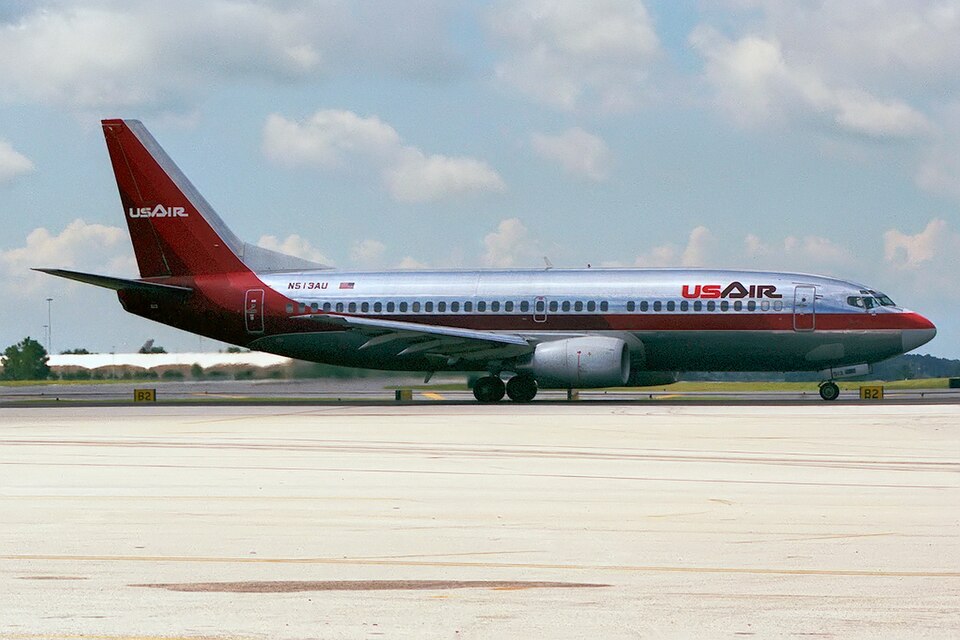
Image Source: Paul Denton, CC BY 4.0, via Wikimedia Commons
What Was the Accusation?
USAir faced intense scrutiny after Flight 427, a Boeing 737-300 flying from Chicago to Pittsburgh, crashed near Aliquippa, Pennsylvania, on September 8, 1994, killing all 132 people aboard. Investigators spent years examining whether the loss of control resulted from pilot action, a wake-vortex encounter, or a malfunction in the Boeing 737 rudder system. The accident also generated criticism of the airline’s handling of victims’ families. Decades later, relatives and investigators interviewed by the Pittsburgh Post-Gazette described serious shortcomings in the carrier’s family response, while one widow told The Washington Post that she did not recall receiving an apology from either USAir or Boeing.
In a September 30, 1997 submission to the National Transportation Safety Board, US Airways—USAir’s renamed corporate identity—mounted a detailed defense of its flight crew. The airline argued that Captain Peter Germano and First Officer Charles Emmett did not command the full-left rudder movement and responded properly using the procedures and knowledge then available. It attributed the crash to an uncommanded full rudder deflection or rudder reversal and faulted the manufacturer for not informing operators about “crossover speed,” below which the aircraft’s lateral controls could not overcome a fully deflected rudder. The submission also said the airline had implemented procedures addressing potential rudder-control problems.
In 1999, the NTSB concluded that the probable cause was loss of control after the rudder moved to its blowdown limit, most likely because a jam in the main rudder power-control-unit servo valve caused the rudder to deflect opposite to the pilots’ command. The final finding substantially supported the airline’s central contention that the crew did not cause the fatal rudder movement. This case therefore represents corporate apologia primarily as a defense against blame for the crew’s conduct and the accident’s cause, rather than a conventional expression of remorse.
Key Apologia Strategies
Denial, Shifting the Blame, Corrective Action, Bolstering
Video
N/A
Transcript
Key excerpts from US Airways’ September 30, 1997 party submission to the National Transportation Safety Board:
“The purpose of this submission is to provide the National Transportation Safety Board with US Airways’ analysis and conclusions regarding the circumstances and causes of the crash of USAir Flight 427. As the investigation is ongoing, US Airways reserves the right to supplement this submission.”
“The investigation revealed that the Boeing 737 rudder control system has certain anomalies which may have resulted in a rudder reversal or uncommanded full rudder deflection on the accident aircraft. As a result, the Board has issued recommendations to correct problems that might exist in the Boeing 737 rudder control system. In addition, US Airways has implemented procedures to deal with potential rudder control problems in the unlikely event they should occur.”
“The facts developed in this investigation do not support a conclusion that the flight crew commanded the full-left rudder deflection that caused this accident.”
“Upon encountering this uncommanded yaw and roll, the flight crew reacted properly by applying aileron and spoiler opposite the direction of the uncommanded yaw and roll. The crew, unaware of the crossover speed concept, let alone the B-737’s crossover speed, attempted to maintain altitude while recovering from the uncommanded yaw and roll.”
“For these reasons, US Airways concludes that the probable cause of the accident was an uncommanded, full rudder deflection or rudder reversal that placed the aircraft in a flight regime from which recovery was not possible using techniques known at the time.”
“Contributing to the accident was the failure of the manufacturer to advise operators of the 737 that there were speeds below which the ailerons and spoilers could not counteract a hardover rudder.”
Sources
National Transportation Safety Board. (1999). Uncontrolled descent and collision with terrain, USAir Flight 427, Boeing 737-300, N513AU, near Aliquippa, Pennsylvania, September 8, 1994 (Aircraft Accident Report NTSB/AAR-99/01). https://www.ntsb.gov/investigations/AccidentReports/Reports/AAR9901.pdf
Related Apologia Cases
Readers interested in this corporate apologia case may also want to review: