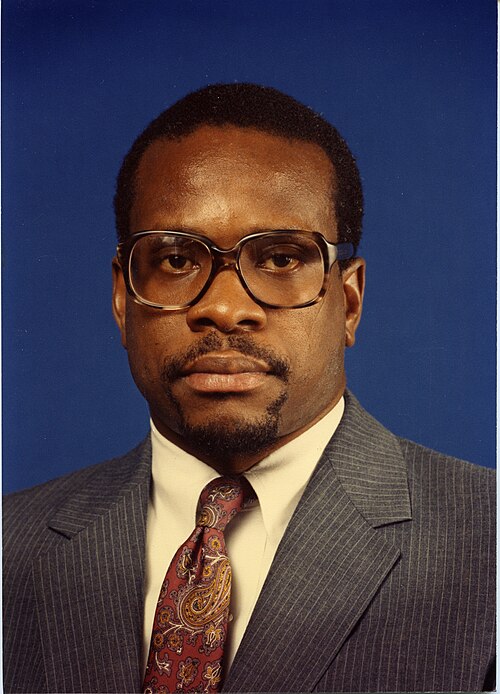
Image Source: Series: Photographs Documenting Agency Activities and Personnel, Records of the Equal Employment Opportunity Commission, Public domain, via Wikimedia Commons
What Was the Accusation?
During Clarence Thomas’s 1991 nomination to the U.S. Supreme Court, University of Oklahoma law professor Anita Hill alleged that Thomas had sexually harassed her while she worked for him at the Department of Education and later at the Equal Employment Opportunity Commission. Hill testified before the Senate Judiciary Committee on October 11 that Thomas repeatedly asked her to go out with him and, after she declined, subjected her to unwanted sexually explicit conversations. She described discussions of pornography, sexual acts, and Thomas’s sexual interests. Thomas categorically denied the allegations.
The accusations transformed what had already been a contentious Supreme Court confirmation into a nationally televised dispute over sexual harassment, race, credibility, workplace power, and the Senate’s treatment of both accuser and accused. Hill’s testimony was heard by an all-male Senate Judiciary Committee, and the proceedings became a lasting reference point in American discussions of workplace sexual harassment. Thirty years later, Hill said the experience helped begin a broader public conversation about harassment but argued that institutional responses to gender violence remained inadequate.
Thomas responded twice on October 11. In his earlier testimony he denied harassing Hill, emphasized his record opposing sexual harassment as chairman of the EEOC, and offered a conditional expression of regret if anything he had said had been misconstrued. After Hill testified, Thomas returned to the committee and issued an emphatic denial. He attacked the confirmation process as a national disgrace and characterized the proceedings as a racially charged effort to destroy him, using the phrase “high-tech lynching.” The Senate confirmed Thomas on October 15, 1991, by a vote of 52–48. Hill has continued to stand by her account, and Thomas has continued to deny sexually harassing her. A later scholarly analysis by William Benoit and Dawn Nill classified Thomas’s principal image-repair strategies as denial, bolstering, and attacking his accusers.
Key Apologia Strategies
Denial, Bolstering, Attacking the Accuser
Video
Transcript
Key excerpts from Clarence Thomas’s October 11, 1991 testimony before the Senate Judiciary Committee:
Senator Biden: The committee will please come to order. Judge, tough day and tough night for you, I know. Let me ask, do you have anything you’d like to say before we begin? And I understand that your preference is which is totally and completely understandable that we go one hour tonight, 30 minutes on each side. Is Am I correct in that?
Judge Thomas: That’s right.
Senator Biden: Do you have anything you’d like to say?
Judge Thomas: Senator, I would like to start by saying unequivocally, uncategorically, that I deny each and every single allegation against me today that suggested in any way that I had conversations of a sexual nature or about pornographic material with Anita Hill, that I ever attempted to date her, that I ever had any personal sexual interest in her, or that I in any way ever harassed her. A second, and I think more important point. I think that this today is a travesty. I think that it is disgusting. I think that this hearing should never occur in America. This is a case in which this sleaze, this dirt, was searched for by staffers of members of this committee, was then leaked to the media, and this committee and this body validated it and displayed it at prime time over our entire nation. How would any member on this committee, any person in this room, or any person in this country, would like sleaze said about him or her in this fashion? Or this dirt dredged up and this gossip and these lies displayed in this manner? How would any person like it?
The Supreme Court is not worth it. No job is worth it. I am not here for that. I am here for my name, my family, my life, and my integrity. I think something is dreadfully wrong with this country when any person, any person in this free country would be subjected to this. This is not a closed room. There was an FBI investigation. This is not an opportunity to talk about difficult matters privately or in a closed environment. This is a circus. It’s a national disgrace. And from my standpoint as a black American, as far as I’m concerned, it is a high tech lynching for uppity blacks who in any way deign to think for themselves, to do for themselves, to have different ideas, and it is a message that unless you kowtow to an old order, this is what will happen to you. You will be lynched, destroyed, caricatured by a committee of the U.S. Senate, rather than hung from a tree.
Sources
Benoit, W. L., & Nill, D. M. (1998). A critical analysis of Judge Clarence Thomas’ statement before the Senate Judiciary Committee. Communication Studies, 49(3), 179–195. https://doi.org/10.1080/10510979809368530