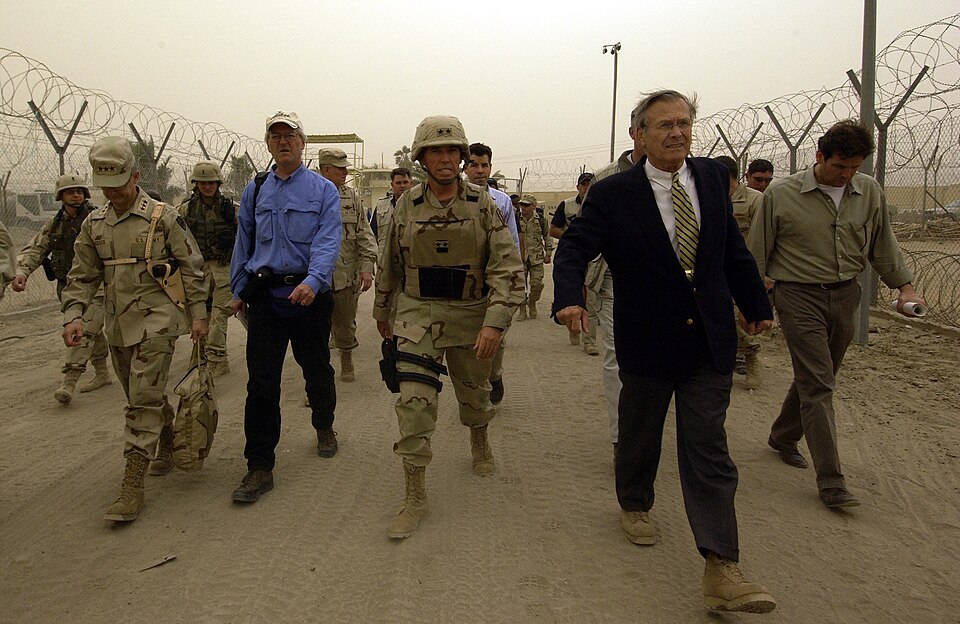
Image Source Tech. Sgt. Jerry Morrison Jr., U.S. Air Force, Public domain, via Wikimedia Commons
What Was the Accusation?
U.S. Secretary of Defense Donald Rumsfeld faced intense criticism in 2004 after photographs exposed the abuse and humiliation of Iraqi detainees at Abu Ghraib prison outside Baghdad. The photographs showed U.S. military personnel subjecting prisoners to degrading treatment, including forced nudity, sexual humiliation, physical abuse, threats, and other forms of mistreatment. An Army investigation led by Maj. Gen. Antonio Taguba found numerous instances of what it characterized as sadistic, blatant, and wanton criminal abuse of detainees. The scandal raised broader questions about discipline, training, leadership, interrogation practices, and accountability within the U.S. military detention system.
As secretary of defense, Rumsfeld also came under criticism for the Pentagon’s handling of the allegations before the photographs became public. Although military investigations had begun months earlier, senior members of Congress and President George W. Bush had not been adequately informed about the seriousness of the abuse before the photographs produced an international scandal. Appearing before the Senate Armed Services Committee on May 7, 2004, Rumsfeld accepted responsibility for failures that occurred under his leadership, acknowledged that he had failed to recognize the importance of elevating the matter to senior government officials, and apologized directly to Iraqi detainees who had been mistreated. He also described investigations and disciplinary measures already underway and said the Defense Department would seek a means of compensating detainees who had suffered serious abuse.
Excerpts from Secretary of Defense Donald Rumsfeld’s Testimony Before the Senate Armed Services Committee (May 7, 2004)
Do each of you solemnly swear that the testimony that you are about to give to the Committee on the Armed Services Committee of the United States will be the truth, the whole truth and nothing but the truth, so help you God?
RUMSFELD: I do.
Mr. Secretary?
RUMSFELD: Mr. Chairman, members of the committee, in recent days there has been a good deal of discussion about who bears responsibility for the terrible activities that took place at Abu Ghraib. These events occurred on my watch. As secretary of defense, I am accountable for them and I take full responsibility.
It’s my obligation to evaluate what happened, to make sure that those who have committed wrong-doing are brought to justice, and to make changes as needed to see that it doesn’t happen again.
I feel terrible about what happened to these Iraqi detainees. They are human beings. They were in U.S. custody. Our country had an obligation to treat them right. We didn’t, and that was wrong.
So to those Iraqis who were mistreated by members of the U.S. armed forces, I offer my deepest apology. It was inconsistent with the values of our nation. It was inconsistent with the teachings of the military, to the men and women of the armed forces. And it was certainly fundamentally un-American.
Further, I deeply regret the damage that has been done. First to the reputation of the honorable men and women of the armed forces, who are courageously and responsibly and professionally defending our freedoms across the globe. They are truly wonderful human beings. And their families and their loved ones can be enormously proud of them.
Second to the president, the Congress and the American, I wish I had been able to convey to them the gravity of this before we saw it in the media.
And finally to the reputation of our country.
The photographic depictions of the U.S. military personnel that the public has seen have offended and outraged everyone in the Department of Defense. If you could have seen the anguished expressions on the faces of those in our department upon seeing those photos, you would know how we feel today.
It’s important for the American people and the world to know that while these terrible acts were perpetrated by a small number of U.S. military, they were also brought to light by the honorable and responsible actions of other military personnel.
There are many who did their duty professionally and we should mention that as well. First, Specialist Joseph Darby, who alerted the appropriate authorities that abuses were occurring. Second, those in the military chain of command who acted promptly on learning of those abuses by initiating a series of investigations, criminal and administrative, to assure that abuses were stopped and the responsible chain of command was relieved and replaced.
Having said that, all the facts that may be of interest are not yet in hand. In addition to the Taguba report, there are other investigations under way and we’ll be discussing those today. And because all the facts are not in hand, there will be corrections and clarifications to the record as more information is learned.
From the witnesses, you will be told the sequence of events and investigations that have taken place since the activities first came to light. I want to inform you of the measures under way to improve our performance in the future. Before I do that, let me say that each of us at this table is either in the chain of command or has senior responsibilities in the Department of Defense. This means that anything we say publicly could have an impact on the legal proceedings against those accused of wrongdoing in this matter.
So please understand that if some of our responses to questions are measured, it is to assure that pending cases are not jeopardized by seeming to exert command influence and that the rights of any accused are protected.
Now let me tell you the measures we’re taking to deal with this issue.
First, to ensure we have a handle on the scope of this catastrophe, I will be announcing today the appointment of several senior former officials who are being asked to examine the pace, the breadth, the thoroughness of the existing investigations and to determine whether additional investigations or studies need to be initiated. They’re being asked to report their findings within 45 days of taking up their duties.
I’m confident that these distinguished individuals will provide a full and fair assessment of what has been done thus far and recommend whether further steps may be necessary.
Second, we need to review our habits and our procedures.
One of the things we’ve tried to do in the department since September 11th is to try to get the department to adjust our procedures and processes to reflect that we’re in a time of war, and that we’re in the information age. For the past three years we’ve looked for areas where adjustments were needed, and we’ve made a great many adjustments. And regrettably we’ve now found another area where adjustments may be needed.
Let me be clear: I failed to recognize how important it was to elevate a matter of such gravity to the highest levels, including the president and the members of Congress.
Third, I’m seeking a way to provide appropriate compensation to those detainees who suffered such grievous and brutal abuse and cruelty at the hands of a few members of the United States armed forces. It’s the right thing to do.
I wish we had known more sooner and been able to tell you more sooner, but we didn’t.
Today we’ll have a full discussion of these terrible acts, but first let’s take a step back for a moment. Within the constraints imposed on those of us in the chain of command, I have a few additional words.
PROTESTER: What about the other abuses in Iraq?
(CROSSTALK)
WARNER: We’ll remain seated for a brief period and suspend the hearing. I ask all persons…
(PROTESTERS SHOUTING)
PROTESTER: Fire Rumsfeld! Fire Rumsfeld! Fire Rumsfeld!
WARNER: Committee will resume the hearing.
Mr. Secretary?
RUMSFELD: First, beyond abuse of prisoners, there are other photos that depict incidents of physical violence toward prisoners, acts that can only be described as blatantly sadistic, cruel and inhuman. Second, there are many more photographs, and indeed some videos. Congress and the American people and the rest of the world need to know this.
In addition, the photos give these incidents a vividness, indeed a horror, in the eyes of the world.
Mr. Chairman, that’s why this hearing today is important. It’s why the actions we take in the days and weeks ahead are so important.
However, terrible the setback, this is also an occasion to demonstrate to the world the difference between those who believe in democracy and in human rights, and those who believe in rule by terrorist code.
We value human life. We believe in individual freedom and in the rule of law. For those beliefs, we send men and women of the armed forces abroad to protect that right for our own people and to give others who aren’t Americans the hope of a future of freedom.
Part of that mission, part of what we believe in, is making sure that when wrongdoings or scandal do occur, that they’re not covered up, but they’re exposed, they’re investigated, and the guilty are brought to justice.
Mr. Chairman, I know you join me today in saying to the world, judge us by our actions, watch how Americans, watch how a democracy deals with the wrongdoing and with scandal and the pain of acknowledging and correcting our own mistakes and our own weaknesses.
And then, after they have seen America in action, then ask those who teach resentment and hatred of America if our behavior doesn’t give a lie to the falsehood and the slander they speak about our people and about our way of life. Ask them if the resolve of Americans in crisis and difficulty, and, yes, in the heartbreak of acknowledging the evil in our midst, doesn’t have meaning far beyond their hatred. Above all, ask them if the willingness of Americans to acknowledge their own failures before humanity doesn’t light the world as surely as the great ideas and beliefs that made this nation a beacon of hope and liberty for all who strive to be free.
We know what the terrorists will do; we know they will try to exploit all that is bad, and try to obscure all that is good. That’s their nature. And that’s the nature of those who think they can kill innocent men, women and children to gratify their own cruel wills to power.
We say to the world, we will strive to do our best, as imperfect as it may be.
Thank you, Mr. Chairman.
WARNER: Thank you, Mr. Secretary.
You and I have had the privilege to know each other for many, many years. We’ve enjoyed a close working relationship. I want to say I found that statement to be strong and in every sense heartfelt by you.
RUMSFELD: Thank you.
WARNER: Mr. Secretary, I was particularly impressed by your phrase, We’re going to watch American democracy in action, as the president and all others address this problem swiftly in accordance with the rule of law and American values.
In the meantime, however, it’s obvious to all of us that the impact of the facts of this case, as they’re unfolding, are affecting our relationship with other nations, our foreign policy. So I ask you, what is that impact, as best you can assess it today? And secondly, will this impact of this situation affect in any way the transition that I and others support to take place on June 30th?
And will it have any impact on other nations in the coalition to consider their continued participation at this time and the chances of adding additional nations?
And lastly, does it have any impact on the force levels that you anticipate, together with your on-scene commanders of CENTCOM, in the near future?
RUMSFELD: Mr. Chairman, those are tough questions. I’m afraid no one has the ability to know precisely what will unfold.
We have seen no shift in coalition countries, in answer to your first question.
About future coalition countries, I think the key determinative there is whether or not we are successful in getting an additional U.N. resolution, in which case I think we will get additional countries to participate.
It certainly will not have any effect on the determination to have sovereign responsibility assumed by Iraqis by June 30.
And I would just say one other thing. We have been enormously disadvantaged by false allegations and lies for the better part of a year — and indeed before that with respect to Afghanistan — by terrorists and terrorist organizations alleging things that weren’t true. So we have taken a beating in the world for things we were not doing that were alleged to be done, and now we’re taking a beating, understandably, for things that did in fact happen. Thank you, sir.
LEVIN: Thank you, Mr. Chairman.
Secretary Rumsfeld, I was struck upon seeing one of the photographs from the prison, depicting three naked prisoners in a lump on the floor being overseen by a number of soldiers, while other soldiers in the cell block were assisting, or were going about their business without any apparent interest in or concern about the obvious abusive treatment, that the conduct that we were witnessing and watching was not aberrant conduct of a few individuals, but was part of an organized and conscious process to extract information.
This picture reinforces the Taguba report, which quotes Sergeant Davis as saying that he witnessed prisoners in the military intelligence hold section, Wing 1-A, being made to do various things that I would question morally. And he quoted the military intelligence folks as saying that Loosen a guy up for us, Make sure he has a bad night, Make sure he gets the treatment, and that the wing belonged to the military intelligence and it appeared that military intelligence personnel approved of the abuses.
Now, in the Taguba report itself, General Taguba says the following, and this is his finding: that military intelligence interrogators and other U.S. government agency interrogators — which I assume includes CIA — actively requested that M.P. guards set physical and mental conditions for favorable interrogation of witnesses, and that personnel assigned to the M.P. company and brigade were, quote, directed to change facility procedures to set the conditions for military intelligence interrogations.
My question to you is: What were those changes that were made, and whether or not they were — it was proper to make changes of the kind that General Taguba refers to?
RUMSFELD: The conclusions you seem to have drawn in your question, Senator Levin, are issues that I believe are probably all being addressed in an investigation that was initiated last month — and I believe it’s called the Fay.
Possibly you, General Smith, have been involved in this and would want to comment.
SMITH: Sir, there has been an investigation that was initiated in mid-April by Major General Fay. And it is to look into exactly those allegations as a result.
LEVIN: Secretary Rumsfeld, would you agree that people who authorized or suggested or prompted the conduct depicted in the pictures that we’ve seen as well, as those who carried out those abuses, must be held accountable? That anybody who authorized, knew about, prompted, suggested in the intelligence community or otherwise, that conduct must be held accountable? That’s my very direct question to you.
RUMSFELD: The pictures I’ve seen depict conduct, behavior that is so brutal and so cruel and so inhumane that anyone engaged in it or involved in it would have to be brought to justice.
LEVIN: Would that include anybody who suggested it, prompted it, hinted at it, directly or indirectly? I just want to know how far up this chain you’re going to go. Are you going to limit this to people who perpetrated it? Or are we going to get to the people who may have suggested it or…
RUMSFELD: That is exactly why the investigation was initiated, that is why it’s being brought forward, and we’ll find what their conclusions are. And I’m sure they will make recommendations with respect to prosecutions.
LEVIN: But in terms of the standard, does anybody who recommended or suggested, directly or indirectly, that conduct in order to extract information, are they also in your judgment, if that occurred, violative of our laws and standards?
RUMSFELD: Certainly anyone who recommended the kind of behavior that I have seen depicted in those photos needs to be brought to justice.
MCCAIN: Were the instructions to the guards…
RUMSFELD: There’s two sets of responsibilities, as your question suggests. One set is the people who have the responsibility for managing the detention process; they are not interrogators. The military intelligence people, as General Smith has indicated, were the people who were in charge of the interrogation part of the process.
And the responsibility, as I have reviewed the matter, shifted over a period of time and the general is capable of telling you when that responsibility shifted.
MCCAIN: What were the instructions to the guards?
RUMSFELD: That is what the investigation that I have indicated has been undertaken…
MCCAIN: Mr. Secretary…
RUMSFELD: … is determining…
MCCAIN: … that’s a very simple, straight-forward question.
RUMSFELD: Well, the — as the chief of staff of the Army can tell you, the guards are trained to guard people. They’re not trained to interrogate, they’re not — and their instructions are to, in the case of Iraq, adhere to the Geneva Convention.
The Geneva Conventions apply to all of the individuals there in one way or another. They apply to the prisoners of war, and they are written out and they’re instructed and the people in the Army train them to that and the people in the Central Command have the responsibility of seeing that, in fact, their conduct is consistent with the Geneva Conventions.
The criminals in the same detention facility are handled under a different provision of the Geneva Convention — I believe it’s the fourth and the prior one’s the third.
MCCAIN: So the guards were instructed to treat the prisoners, under some kind of changing authority as I understand it, according to the Geneva Conventions?
RUMSFELD: Absolutely.
MCCAIN: I thank you, Mr. Chairman.
KENNEDY: Thank you very much. Thank you, Mr. Chairman.
To the people in the Middle East, and too often today, the symbol of America is not the Statue of Liberty, it’s the prisoner standing on a box wearing a dark cape and a dark hood on his head, wires attached to his body, afraid that he’s going to be electrocuted.
These incidents of torture and abuse resulted in a catastrophic crisis of credibility for our nation.
Now, since the beginning of the war, the International Committee of the Red Cross provided the Pentagon officials with reports of abuses at this prison, saying that some of them were tantamount to torture. They issued serious complaints during an inspection of the prison in October of 2003 and at several other times.
The State Department and the Coalition Provisional Authority appealed to you to stop the mistreatment of the military detainees. Secretary Powell raised this issue at Cabinet meeting and elsewhere, pleading with officials from your department, Mr. Secretary, to see that detainees were properly cared for and treated, and your department failed to act.
The military leadership put the troops in charge of the prison who weren’t trained to do the job, and they assigned far too prisoners (sic) to the prison than were required to do the job right, and they relied on the civilian contractors to perform military duties, as I understand, including the interrogation of Iraqi prisoners.
And as Senator Levin pointed out, the top-level Defense officials directed guards at the prison to set physical and mental conditions for favorable interrogation of the detainees, a decision that directly resulted in the abuses.
And the military leadership failed to respond in a systematic way even after it initiated the 35 criminal investigations into alleged mistreatment of detainees in Iraq and Afghanistan, 25 of these investigations involving a death. I know that Secretary Brownlee referred to this.
In particular, in December of 2002, military doctors at the Bagram Air Base in Afghanistan ruled that two Afghan men in U.S. custody died from blunt force injuries. No one in the military has been held accountable for those homicides.
You and your senior leadership have shown, I believe, a disregard for the protection of the Geneva Conventions in detainee operations. In January, 2002, you were asked why you believe the Geneva Conventions do not apply to detainees in Guantanamo. You replied that you did not have the slightest concern about their treatment, in light of what has occurred in 9/11.
According to the New York Times, you have known about the graphic photographs, evidence of abuse in the Abu Ghraib prison since mid- January. You told President Bush about these reports of abuse shortly thereafter. And yet, rather than work with Congress to deal with the problem together, you and other top Defense Department officials have apparently spent the last three weeks in preparing the public relations plan.
Can you tell us what exactly did you tell the president about these reports of abuse in late January, and what did he say, and what did you do about it, and why month after month after month had to pass before anything has happened and then we find out that the pictures came out and that the president is indeed angry?
RUMSFELD: First, Senator Kennedy, your statement that other agencies of government were concerned about detainees and the Department of Defense failed to act is simply not correct.
KENNEDY: This wasn’t brought to your attention by the secretary of the State Department?
RUMSFELD: I’ll respond. I did not say that. I said your statement that the Department of Defense…
KENNEDY: Well, it was brought to you then by the State Department. We don’t want to parse words. Was this brought to you by the State Department? I mentioned Secretary Powell. Question is whether this was brought to you and when did you know. When did you know it?
You gave us a laundry list in your presentation about the timeline on it. I’m trying to find out, because it has been published, that you were notified about this a series of times and advised to do something about it and nothing was done.
RUMSFELD: It’s not correct to say Nothing was done. You’re making a set of conclusions that are just simply not accurate.
We’ve had numerous discussions, interagency, on detainees. All in all, there have been some 43,000 people who were captured or detained in Iraq, of whom 31,850 have already been released. That is a big task for the Army to undertake. The…
KENNEDY: Can I…
RUMSFELD: … the actions of the ICRC — you said they came in and indicated concerns about the Abu Ghraib prison. That’s correct. And the prison officials began the process of making corrections and the general’s report — Taguba — found that a number of those things were already under way, in terms of corrections. And when he made his study, a number of additional things and corrections were made.
So it seems to me that the ICRC report was helpful, and that the military command, as I understand it, undertook a series of corrections.
Now, with respect to when were we knowledgeable of this, the situation was this: Specialist Darby told the CID that he had information about abuses in the prison. I believe it was on the 13th or 14th of January. By the 15th or 16th, an investigation had been initiated. And the Central Command public affairs people went out and told the world — they told everyone in the world that there were allegations of abuse and they were being investigated.
Again, by mid-March, when some criminal — I don’t know the legal term but — some criminal actions were initiated, the Central Command’s public affairs people went out again and announced that not only were there allegations of abuses but they listed the types of abuses. And then this is to the world. Everyone knew it. CNN was there asking questions.
And that is the time frame when General Myers and I were meeting with the president and discussed the reports that we had obviously heard because they weren’t hiding anything. They disclosed it to the world.
LIEBERMAN: Thank you, Mr. Chairman.
Mr. Secretary, the behavior by Americans at the prison in Iraq is, as we all acknowledge, immoral, intolerable and un-American. It deserves the apology that you have given today and that have been given by others in high positions in our government and our military.
I cannot help but say, however, that those who were responsible for killing 3,000 Americans on September 11th, 2001, never apologized. Those who have killed hundreds of Americans in uniform in Iraq working to liberate Iraq and protect our security have never apologized. And those who murdered and burned and humiliated four Americans in Fallujah a while ago never received an apology from anybody.
So it’s part of — wrongs occurred here, by the people in those pictures and perhaps by people up the chain of command.
But Americans are different. That’s why we’re outraged by this. That’s why the apologies were due.
And that’s why I hope as we go about this investigation, we do it in a way that does not dishonor the hundreds of thousands of Americans in uniform who are a lot more like Pat Tillman and Americans that are not know, like Army National Guard Sergeant Felix Del Greco of Simsbury, Connecticut, who was killed in action a few weeks ago; that we not dishonor their service or discredit the cause that brought us to send them to Iraq, because it remains one that is just and necessary.
We’ve got to get to the whole truth here, and nothing but the truth. We can’t be defensive. We’ve got to be aggressive about it. And as Senator McCain said, we’ve got to do it quickly so that we and you and most of all our soldiers can get back to fighting and winning the war on terrorism with determination.
As far as I’m concerned, we do have to know how this happened. And we have to know it so we can stop it from happening ever again.
You’ve said that the behavior of those soldiers was fundamentally un-American. I agree with you. And this goes way back to the first American declaration, the Declaration of Independence, where we said that every human being has those rights as an endowment of our creator.
That even goes to human beings who have been apprehended by our military as they have been in Iraq because they are suspected of being part of the terrorists, of the jihadists, of the foreign fighters, of the Saddam loyalists who are killing Americans and Iraqis every day. We know that people are flawed. And that’s why we believe in the rule of law, to try to make this better and punish those who fall below appropriate humane standards.
In that regard, it seems to me when it comes to the treatment of prisoners and detainees and conditions of combat, the Geneva Convention adopted by the United States as the law of the land, and that has been implemented by U.S. Army Regulation 190-8.
You made some controversial statements early on, after Afghanistan, that said, The Geneva Convention was not relevant here — that By-in-large — and I’m quoting — generally, American military interrogators of prison guards would try to carry out the rights of prisoners and detainees according to the Geneva Convention.
But I want to ask you today, as you look back to that, do you think you were right? Did anything replace the rules of the Geneva Convention or Army Regulation 190-8? And if not, why not?
RUMSFELD: Senator, the president of the United States made a determination in early 2002 that the Geneva Convention provisions did not apply to our conflict with Al Qaida although he concluded the Geneva Conventions did apply to the conflict with Taliban. That was a decision by the president.
He determined the Taliban detainees did not qualify as prisoners of war under the third Geneva Convention criteria for prisoners of war. He also made clear that it was and will continue to be the policy to treat detainees humanely, and in a manner that was consistent with the Geneva Conventions. So these people were treated consistent to the Geneva Conventions. But he made a distinction with respect to Al Qaida and…
LIEBERMAN: Are these detainees, do you assume, members of Al Qaida — that is, the thousands that have been held in Iraq? Or are they in another status?
RUMSFELD: Oh no, the president announced from the outset that everyone in Iraq who was a military person and was detained is a prisoner of war, and therefore the Geneva Conventions apply.
And second, the decision was made that the civilians or criminal elements that are detainees are also treated subject to the Geneva Convention, although it’s a different element of it. I think it’s the 4th instead of the 3rd.
LIEBERMAN: I appreciate the clarification, because I was not aware of that; that you would say that all those held in prison, including those who were abused here, had the rights of prisoners of war…
RUMSFELD: Absolutely.
LIEBERMAN: … under the Geneva Convention.
RUMSFELD: Absolutely. That’s true…
LIEBERMAN: And therefore the fault clearly was that those we’ve seen, and hopefully not others, were not either properly trained, properly disciplined or in any case not observing the law of the United States of America with regard to the rights of prisoners of war.
MYERS: If I may, I think that’s exactly right. It’s abhorrent behavior.
The Taguba report, if you recall, looked at four installations where the 800th M.P. Brigade had operations. They found abuse in one, and that’s Abu Ghraib. They found abuse in one.
LIEBERMAN: My time’s up. Thank you.
RUMSFELD: Thank you very much.
GRAHAM: And that is an honest and fair answer.
And, Secretary Rumsfeld, people are calling for your resignation. Somebody is drafting an article of impeachment against you right now. I’ve got my own view about people who want to call for your resignation before you speak, but I’ll leave that to myself.
Do you have the ability, in your opinion, to come to Capitol Hill and carry the message and carry the water for the Department of Defense? Do you believe, based on all things that have happened and that will happen, that you’re able to carry out your duties in a bipartisan manner? And what do you say to those people who are calling for your resignation?
RUMSFELD: Well, it’s a fair question. Certainly since this firestorm has been raging, it’s a question that I’ve given a lot of thought to.
The key question for me is the one you pose, and that is whether or not I can be effective. We’ve got tough tasks ahead. The people in the department, military and civilian, are doing enormously important work here, in countries all over the world and the issue is: Can I be effective in assisting them in their important tasks?
Needless to say, if I felt I could not be effective, I’d resign in a minute. I would not resign simply because people try to make a political issue out of it.
BILL NELSON: And when you all had this discussion with the president, what did the president say that you should do about those abuses?
RUMSFELD: Well, I don’t know that I’m going to get into private discussions with the president. If I don’t remember when it was, my guess is it was more an information item from us to him where we were transmitting and saying, here’s the problem.
The problem at that stage was one-dimensional. It wasn’t three- dimensional. It wasn’t video. It wasn’t color. It was quite a different thing, and as I indicated in my remarks, if there’s a failure, it’s me.
It’s my failure for not understanding and knowing that were hundreds or however many there are of these things that could eventually end up in the public and do the damage they’ve done.
But I certainly never gave the president a briefing with the impact that one would have had you seen the photographs or the video. I mean, let there be no doubt about that. He was just as blind sided as the Congress and me and everyone else.
NELSON: Mr. Secretary, what are your instructions from the president to inform him of matters such as this?
RUMSFELD: Well, I don’t know that I’m going to — I mean, we have had so many discussions. And clearly, a secretary of defense has the responsibility to try to put himself in the shoes of the president and say, what ought a president to know about all the thousands, tens of thousands, of things that are happening in the Department of Defense at any given time?
And we sit down every week, and General Myers and I go through all the things that we’ve got going on, and pick and choose and say, What are the things that are appropriate? What do we owe him so that he can provide the kind of leadership that this country deserves? And what is it the department’s doing now that we can get in his head and apprise him of, so that he knows about that? And it may be a contingency plan. It may be a problem of personnel. It may be any — it just runs the gamut.
DOLE: Thank you, Mr. Chairman.
I certainly want to echo the sentiments of my colleagues and the American people by saying that I’m extremely disappointed that any American, and especially one in uniform, would mistreat or humiliate another human being and commit such atrocious acts.
The acts depicted in those photographs shown around the world do not in any way represent the values of the United States of America or our armed forces. I know our military men and women serve their country with great honor.
The abuse of these Iraqi detainees is a serious issue, not just because it violated human rights. It also tarnished our nation’s credibility.
Furthermore, the inflammatory actions of a few have provided our enemies with a lucrative venue to question American values and our true intentions in the war on terror.
Unfortunately, a breakdown of discipline combined with a handful of morally deficient individuals has resulted in serious implications for our national security and the security of over 130,000 servicemembers striving to accomplish our goals in Iraq.
Over the past year, through dedication and sacrifice, and, I must emphasize, strong military leadership, our soldiers have made incredible breakthroughs. The United States and its allies have freed 50 million people from oppressive regimes, removed credible threats to our nation’s security, destroyed burgeoning terrorist incubators, and set two countries on the path to democratic and free market reform. In Iraq, 2,600 schools have been rehabilitated and now more than 5.5 million children are enriching their minds free from the corruption of a repressive regime and its teachings. Women now have a voice in their own government. All 240 hospitals in Iraq are open. More than 1,200 clinics have been established. And on the streets and in the countryside, each day our military medical professionals offer assistance to the citizens of Iraq in addition to caring for their own.
After 30 years of being denied the most fundamental freedoms, today more than 170 independent newspapers are currently operating throughout Iraq, providing each member of that country an opportunity to participate in free and robust debate and, yes, the opportunity to view those horrendous pictures.
Trust among the Iraqi people had slowly been established. Bonds have been made. And sadly for now many of those bonds have been broken.
This legislative body is absolutely correct in focusing on the root causes behind these instances of prisoner abuse and doing everything within its power to ensure that such abuse never, never happens again. And I would expect no less from the Department of Defense to do the same. Transparency is of the utmost importance to our nation’s credibility and security.
Fundamental to our success in the global war on terror is winning the hearts and minds of freedom-loving people who were held captive by a violent few. We are not company to that violent element and we denounce anyone who is.
Secretary Rumsfeld, the damage already done cannot be swept away but it can be repaired. You touched briefly on your plans for a way ahead. Could you go into more detail on this plan? Will it require more or different troops, quicker processing of detainees, more Iraqi police involvement?
You mentioned reparations. Could you please provide more details?
RUMSFELD: I don’t think I used the word reparations. I think — I hope — I used the word compensation for the detainees who were cruelly treated. And I am told that we have — the lawyers have looked into it and we believe there are authorities where we can do that and it is my intention to see that we do do it, because it is the right thing.
With respect to the processing of detainees, in Iraq a total of 43,671 were captured. We have released 27,796 and transferred 4,054, and we currently detain something in the neighborhood of 11,821 which includes 3,842 of the so-called MEK — which are really not detainees; they’re in a separate status. So it’s really closer to 7,000 or 8,000 that are currently detained.
The key is to process them as rapidly as possible. And General Miller, who was out there and has been addressing all of these things — they also believe a key element is to see that they are properly identified and that their families know they’re there and why they’re there and that there isn’t a — it isn’t mysterious, and that we continue to process them.
The only people that need to be retained, obviously, are the ones that are either criminals — and that’s a different category, and a number of them are — or they are individuals who are terrorists and need to be kept off the streets.
Or they have intelligence value and people have got to find out what it is they know so we can track down the remaining remnants of the Baathist regime and the Fedayeen Saddam people and the people that are out killing Iraqis — not just Americans and coalition people, but are killing Iraqis every single day in that country.
BAYH: I appreciate your candor.
My second question has to do with some comments that Senator Lieberman made, and I would like to associate myself with what I thought were very appropriate and moving comments by Senator Lieberman.
I believe very strongly that our cause — and these are not words I use frequently — but that our cause is morally superior to our adversaries’, both the terrorists we fight and those who now seek to undo the future of a free Iraq.
There is growing concern by the supporters of this cause that this situation that we’re inquiring into today is part of a broader problem, that the effort may be bogging down, that we may be approaching a tipping point, that momentum needs to be regained if we’re going to prevail.
I’d like to just read a couple of sentences from a column in yesterday’s New York Times by Tom Friedman, who supported this endeavor in Iraq. He says, We are in danger of losing something much more important than just this war in Iraq. We are in danger of losing America as an instrument of moral authority and inspiration in the world. This administration needs to undertake a total overhaul of its Iraq policy. Otherwise it is courting a total disaster for us all. And he goes on to say how he hopes that such an overhaul can be undertaken because we need to prevail in Iraq.
So my question, Mr. Secretary, my final question is just very simply, do you believe we’re on the right course presently? Or is dramatic action necessary to regain the momentum so that we can ultimately prevail in what is a very noble and idealistic undertaking?
RUMSFELD: I do believe we’re on the right track. It’s a tough road. It’s a bumpy road. It’s always been bumpy going from a vicious dictatorship to something approximating a representative government that’s respectful of its different, varied religious and ethnic groups. It’s not an easy path.
I am convinced that we are doing exactly what ought to be done, and that is to pass responsibility for that country to the Iraqis. I am convinced we’re doing exactly what ought to be done in recognizing that they need to have the ability to provide for their own security, which is why so much effort’s gone into developing police and civil defense corps and an army and border patrols and site protection people.
We do not want America — they do not want Americans or coalition forces in their country over a prolonged period, and goodness knows we don’t want to be there. The only proper way to pass it off is if they have their own security forces. Which is why we’re spending the money and making the effort. It’s why General Abizaid and General Sanchez and General Petraeus now are over there working that problem. And I think that we’ve got a crack at doing it.
I don’t think it’ll be smooth. I think it’ll be rough. It’ll be bumpy. But if you don’t take your hand off the bicycle seat, you’re not going to be able to ride the bike. And we’ve got to do that. And we’re doing it.
CLINTON: Thank you, Mr. Chairman. I think, Mr. Secretary, that you can discern from the questions that there are still many issues that we need further clarification on. I particularly look forward to the answer that you will provide to Senator Reed’s last question — following up on his line of questioning concerning the enabling of interrogation by M.P.s, something which, based on Army regulations, was not to be either done or condoned.
But, Mr. Secretary, in January 2002, when you publicly declared that hundreds of people detained by U.S. and allied forces in Afghanistan do not have any rights under the Geneva Convention, that was taken as a signal.
And it is clear in looking through the number of investigations that are currently ongoing, that it wasn’t just this particular battalion but others that did not receive appropriate training and information about their responsibilities with respect to detention or the Geneva Convention.
The atrocities that have been depicted in photographs were very graphically, verbally, described in the Taguba report. It doesn’t take a lot of imagination to read those descriptions and have one’s stomach just turn in disgust.
The focus on the pictures being released is, with all due respect, missing the point. The report was well known, and apparently discussed on numerous occasions. And obviously, the release of the pictures to the entire world was devastating.
But the underlying conduct, and the failure of the command, both at the site and further up the chain, to act with the appropriate quick response, is really at the heart of what the most serious problems we face here today are. The information in the Taguba report links the atrocities at Abu Ghraib to Camp Buka. In fact, some of the same people, some of the same command, some of the same M.P.s were involved apparently.
And with respect to the recommendations at the end of General Taguba’s report, they call for establishing the conditions with the resources and personnel required to prevent future occurrences of detainee abuse.
I would appreciate, since we don’t have time in this round of questioning, to receive for the committee a report about exactly how that is being handled. What changes have been made? Are the Geneva Convention training going on now? Are the appropriate rules being posted in both English and Arabic?
And certainly an explanation as to the adequacy of the punishment that was meted out because, with respect to who was being punished for what, there is a clear distinction — at least as reported by General Taguba — between enlisted personnel and those up the command.
But I’m also concerned by a related matter. And let me just quickly reference the case of Chaplain Yee, the Muslim Army chaplain from Guantanamo Bay who was arrested and placed in solitary confinement. Ultimately all of the charges were dropped after his reputation was sullied. It’s obvious that the information about this particular case came from government sources. It was pushed out and it was widely disseminated.
So, Mr. Secretary, how is it that a case with no basis in fact gets such widespread publicity, based on information from government sources, while egregious conduct like that at the Abu Ghraib prison is cloaked in a classified report, and is only made available when the investigation is leaked to the press?
RUMSFELD: Well, Senator, first let me say, with respect to the question that Senator Reed raised, I can’t conceive of anyone looking at the pictures and suggesting that anyone could have recommended, condoned, permitted, encouraged, subtly, directly, in any way, that those things take place.
Second, the decision that was made by the president of the United States that you referred to was announced. And in the announcement it was said that the Al Qaida in Guantanamo that are captured in the world, mostly in Afghanistan, would be treated consistent with the Geneva Convention. That is a fact.
You say the report was well known. I don’t know how you know that. All I know is when it made the public, when somebody took a secret document out of prosecutorial channels and released it to the press, I do not believe it was yet anywhere in the Pentagon. Certainly, I had not been given it or seen it.
I quite agree with you. When you read the report, you do get an impression, as you suggested, that there is something much worse than what was in the press release, for example, in January or the discussion in March by the Central Command. But that was not something that had been moved past the Central Command, to my knowledge. It may have been somewhere in the Department of Defense, but certainly I had not received a copy. It was still in those channels.
DAYTON: And whatever the intentions may be, sir, the result is always the same. And it’s, I think, terribly tragic that the president, who wants to expand democracy around the world, by actions of his own administration is undermining that democracy in the United States. That’s always the result when people try to control information, delay it, manage it and suppress it, it has that result. It’s antithetical to a democracy.
RUMSFELD: May I speak a minute, Mr. Senator?
Throughout the history of this country, there have been instances where military situations have existed that have led government to talk to members of the media and make an editorial request of them that they delay for some period disclosing some piece of information. It is not against our history. It is not against our principles. It is not suppression of the news. And it’s a misunderstanding of the situation to say it is.
DAYTON: It is against our principles. It’s against our principles when you come before 40 to 45 members of the Senate three hours before that news report is going to occur and don’t mention one word about it, sir.
That is antithetical to democracy and the Constitution, which has the Senate and the House as co-equal responsibility for this country.
I want to just ask about the escalation of American forces, sir. You’re bringing in, in response to all of this — and this is also important. This is the future of this nation and the people who are over there.
You’re increasing the number of forces, the number of tanks over there. How can this have anything to do but to escalate the level of violence, the opposition of Iraqis, intensify the hatred across the Arab world to the United States, and more atrocities? How can this have any result other than to put us deeper into this situation and make the conditions there worse for our forces and for our nation and for the world?
WARNER: Senator, I’m going to ask that the witnesses respond to your important question for the record. And I thank your cooperation.
Mr. Secretary and witnesses, we’ve had a very thorough exchange of views. We’ve had a full and complete hearing. I wish to commend my colleagues. And I wonder if you might indulge the majority leader for one minute.
LEVIN: Mr. Chairman, could the answers for the record which the secretary has promised be expedited given the circumstances? Would that be all right?
WARNER: Yes, absolutely. It’ll be done.
FRIST: Thank you, Mr. Chairman.
Mr. Secretary, thank you for appearing before the Armed Services Committee today. It has been important, is important for this body, the United States Senate, to hear from you about the reprehensible incidents at Abu Ghraib prison.
Needless to say, the individuals that committed these despicable acts must be held accountable, justice must and will be served in a swift and a fair and transparent matter.
We are all troubled by the fact that actions of a few have tainted the efforts of all Americans who are serving so nobly abroad.
Mr. Secretary, I commend you for taking responsibility for what occurred at Abu Ghraib prison. If we’re ever going to repair the damage done to our efforts in Iraq and to the reputation of the armed forces, it’s important that we get all the facts out in a quick and a thorough manner.
The committees of jurisdiction here in the Senate will be conducting their own inquiries into this matter. We do look forward to regular updates from you and others on the panel and the department as your investigations proceed, as well as updates as to any other actions you may take to ensure that justice is served and heinous acts never occur again.