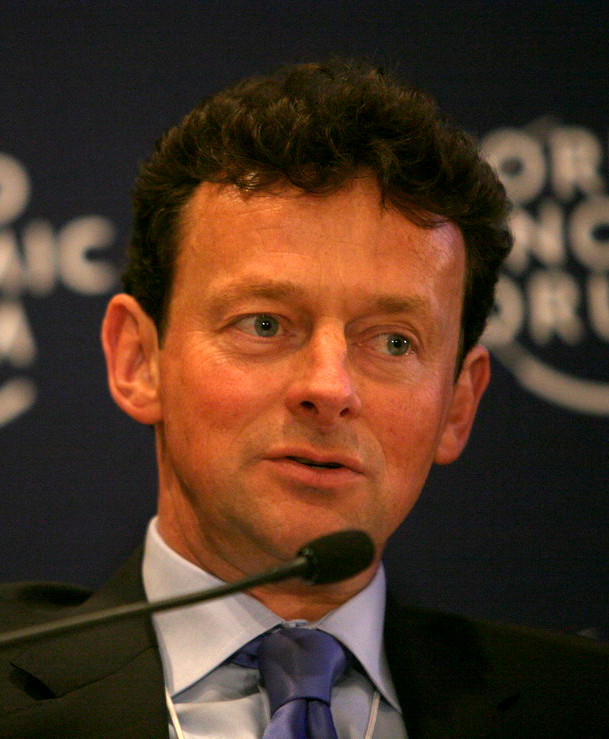
Image Source: World Economic Forum, CC BY-SA 2.0, Wikipedia Commons
What Was the Accusation?
BP and its chief executive, Tony Hayward, faced intense criticism following the April 20, 2010 explosion aboard the Deepwater Horizon drilling rig at the Macondo Prospect in the Gulf of Mexico. Eleven workers were killed in the explosion, and oil began flowing from the damaged well into the Gulf. The U.S. Environmental Protection Agency later reported that approximately four million barrels of oil escaped during the 87 days before the well was capped on July 15, making the Deepwater Horizon disaster the largest spill in the history of marine oil drilling operations. The spill damaged marine and coastal environments and disrupted fishing, tourism, and other economic activity throughout the Gulf Coast.
As BP’s chief executive, Hayward became the company’s most visible spokesperson during the crisis. His public response attracted additional criticism because several remarks appeared to critics to minimize the disaster or demonstrate insensitivity toward people affected by it. His public standing was particularly damaged by his May 2010 remark that he wanted his “life back,” which drew condemnation because eleven workers had died and Gulf Coast residents were confronting environmental and economic losses. Hayward later acknowledged that the comment had been inappropriate. His crisis communication therefore became part of the larger controversy surrounding BP’s handling of the disaster.
On June 17, 2010, Hayward testified before the U.S. House Committee on Energy and Commerce’s Subcommittee on Oversight and Investigations during a hearing titled “The Role of BP in the Deepwater Horizon Explosion and Oil Spill.” In his prepared testimony, Hayward said the explosion, fire, and spill should never have happened and expressed sorrow over the disaster. He offered condolences to the families and friends of the eleven workers who died, acknowledged the suffering of Gulf Coast communities, and said BP would fulfill its obligations to clean up the spill and address its environmental and economic consequences. He also emphasized that investigations into the cause were continuing and distinguished BP’s responsibilities as a responsible party under federal law from unresolved questions of legal liability.
Hayward’s congressional appearance did not end the criticism. During questioning, lawmakers pressed him about BP’s decisions before the blowout, while Hayward repeatedly declined to reach conclusions about matters he said remained under investigation or in which he had not personally participated. Two days after the hearing, his attendance at a yacht race off England’s Isle of Wight generated another round of criticism while the spill response continued in the Gulf. Hayward subsequently stepped down as BP’s chief executive. The legal aftermath also established facts unavailable when he testified: in January 2013, BP Exploration and Production Inc. pleaded guilty to 14 criminal counts arising from conduct leading to and following the disaster, including 11 felony manslaughter counts, obstruction of Congress, and violations of the Clean Water Act and Migratory Bird Treaty Act. The company was sentenced to pay $4 billion in criminal fines and penalties.
Tony Hayward’s Prepared Testimony Before the House Committee on Energy and Commerce Subcommittee on Oversight and Investigations (June 17, 2010):
Mr. Hayward. Chairman Waxman, Chairman Stupak, Ranking Members Barton—-
Mr. Stupak. If you will suspend, please, sir. [Disturbance in hearing room.]
Mr. Stupak. Before we begin with Mr. Hayward, let me again just mention those of you in our audience, emotions run high on this issue, but we have a hearing to conduct here. We are going to conduct our hearing; it’s going to be done with proper decorum.
Mr. Hayward, when you are ready, we are going to start the clock over. You may begin.
Mr. Hayward. Chairman Waxman, Chairman Stupak, Ranking Member Barton, Ranking Member Burgess, members of the committee, I am Tony Hayward, chief executive of BP. The explosion and fire of the Deepwater Horizon and the resulting oil spill resulting in the Gulf of Mexico—-
Mr. Stupak. Excuse me, Mr. Hayward. Could I ask you to pull that up? Some of the Members are having trouble hearing, probably over the clicking of the cameras. But if you could just pull it a little closer. Thank you.
Mr. Hayward. The explosion and fire aboard the Deepwater Horizon and the resulting oil spill in the Gulf of Mexico never should have happened, and I am deeply sorry that it did. When I learned that 11 men had lost their lives, I was personally devastated. Three weeks ago I attended a memorial service for those men, and it was a shattering moment. I want to offer my sincere condolences to their friends and families. I can only begin to imagine their sorrow. I understand how serious this situation is. It is a tragedy.
I want to speak directly to the people who live and work in the gulf region. I know that this incident has had a profound impact on your lives and caused great turmoil, and I deeply regret that. I also deeply regret the impact the spill has had on the environment, the wildlife, and the ecosystem of the gulf.
I want to acknowledge the questions that you and the public are rightly asking. How could this happen? How damaging is the spill to the environment? Why is it taking so long to stop the flow of oil and gas into the gulf?
We don’t yet have all the answers to these important questions, but I hear and understand the concerns, frustrations and anger being voiced across the country, and I know that these sentiments will continue until the leak is stopped and until we prove through our actions that we are doing the right thing.
Yesterday we met with the President of the United States and his senior advisers. We discussed how BP could be more constructive in the government’s desire to bring more comfort and assurance to the people of the Gulf Coast beyond the activity we have already done. We agreed in that meeting to create a $20 billion claims fund to compensate the affected parties and pay for the costs to Federal, State and local governments of the cleanup and environmental mitigation. We said all along that we would pay these costs, and now the American people can be confident that our word is good.
I have been to the Gulf Coast. I have met with fishermen, business owners and families. I understand what they are going through, and I promised them, as I am promising you, that we will make this right. After yesterday’s announcement, I hope that they feel we are on the right track.
I am here today because I have a responsibility to the American people to do my best to explain what BP has done, is doing, and will do in the future to respond to this terrible accident.
First, we are doing everything we can to secure the well and in the meantime contain the flow of oil. We are currently drilling two relief wells. We believe they represent the ultimate solution. We expect this to be complete in August.
Simultaneously we have been working on parallel strategies to minimize or stop the flow of oil. While not all of them have met with success, it appears that our latest containment effort is now containing about 20,000 barrels a day. By the end of June, we expect to have equipment in place to handle between 40- and 50,000 barrels a day, and, by mid-July, between 60- and 80,000 barrels a day.
Second, I have been clear that we will pay all necessary cleanup costs. We have mounted what the Coast Guard has recognized as the largest spill response in history. We have been working hard on the leadership of the unified command to stop the oil from coming ashore, and while we are grateful these efforts have reduced the impact of the spill, any oil on the shore is deeply distressing. We will be vigilant in our cleanup.
Third, as I have made clear from the beginning, we will pay all legitimate claims for losses and damages caused by the spill. Those are not just words. We have already paid out more than $95 million, and we have announced an independent claims facility headed by Ken Feinberg to ensure the process is as fair, transparent and rapid as possible.
Fourth, we need to know what went wrong so that we as a company and we as an industry can do better. That is why, less than 24 hours after the accident, I commissioned a nonprivileged investigation. I did it because I wanted to know what happened, and I want to share the results.
Right now it’s simply too early to say what caused the incident. There is still extensive work to do. A full answer must await the outcome of multiple investigations, including the Marine Board.
To sum up, I understand the seriousness of this situation and the concerns, frustrations and fears that have been and will continue to be voiced. I know that only actions and results, not mere words, ultimately can give you the confidence you seek.
I give my pledge, as the leader of BP, that we will not rest until we make this right. We are a strong company, and no resources will be spared.
We and the entire industry will learn from this terrible event and emerge stronger, smarter and safer. Thank you.
U.S. Government Publishing Office. (2010, June 17). The role of BP in the Deepwater Horizon explosion and oil spill: Hearing before the Subcommittee on Oversight and Investigations of the Committee on Energy and Commerce, House of Representatives, 111th Congress.https://www.govinfo.gov/app/details/CHRG-111hhrg77914