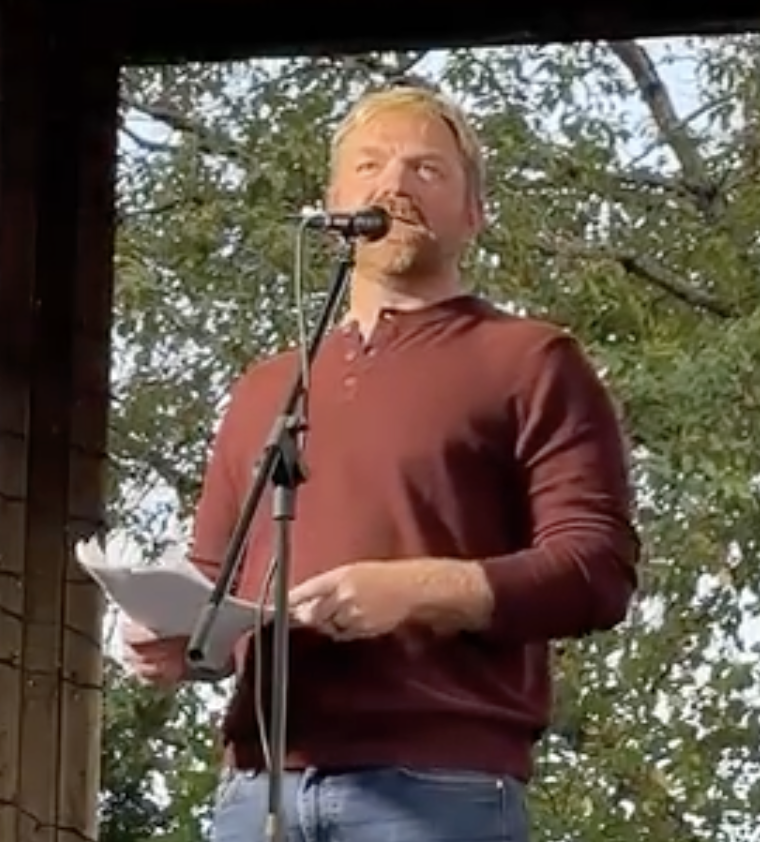
In June 2026, Graham Platner, the Democratic nominee for U.S. Senate in Maine, faced a second major public apology episode after The New York Times reported new allegations from women who had dated him before he became a political figure. The report described accusations of emotionally volatile and demeaning behavior, heavy drinking, infidelity, physically intimidating conduct, and offensive comments about women. One former girlfriend, Lyndsey Fifield, alleged that Platner had grabbed or restrained her during arguments and claimed that he had known for years that his chest tattoo resembled or referenced the Nazi Totenkopf symbol. Platner denied the most serious allegations, especially claims involving physical misconduct and the claim that he knowingly kept a Nazi-associated tattoo, calling those accusations false and politically motivated.
This controversy followed an earlier 2025 apology over Platner’s resurfaced Reddit posts and tattoo controversy, making this the second time he had to explain and apologize for past behavior during his Senate campaign (see other Public Apology Central page). In this newer apology, Platner acknowledged that he had gone through a dark period after military service, struggled with undiagnosed PTSD, self-medicated with alcohol, and had been a “far from perfect boyfriend.” He said he took responsibility for that personal conduct and wished he had been better, while insisting that the allegations went beyond the truth. The controversy intensified Democratic anxiety about the Maine Senate race, with some party figures worried that Platner’s personal history could damage the party’s chance to defeat Republican incumbent Susan Collins.
Chris Haynes: Graham Plattner, Democratic candidate for Senate in Maine, joins me now. Mr. Plattner, it’s good to have you on. Thank you so much for doing this.
Graham Platner: Thanks, Chris. I really appreciate it. Thanks for having me on.
Haynes: I just want to say at the start that, like, you know, we’ve had you on before. And I think you and I are both people that, in other contexts, talk about income inequality and health care and all those issues, which are extremely important. And we devote a lot of time to you on this program. This is not, you know, the thing that we spend a lot of time chasing. But, you know, there’s some serious stuff there I want to go through with you. And I think voters have a right to know about it. And I want to start with what Ms. Fifield says about being rough is the term the Times. And I’m going to just read you the account so you have it. This is from the Times. Mr. Plattner could be rough with her, Ms. Fifield said, particularly when they were drinking, leaving her shaken and sometimes afraid. In the interviews, she grappled with how to process her experiences. She was quick to know he never hit me, never punched me. She said he regularly grabbed her by the shoulders, sometimes hard enough to leave marks. On one occasion, yanked her out of a cab by her wrist after an argument when she wanted to stay in the car. During one argument, she recalled he twisted her arm behind her back, shoved her into a bedroom and held the door closed from the other side so she couldn’t get out, telling her to remain there until she was calm. Eventually, Ms. Fifield said she fell asleep and left the next morning. It hurt, she said, but she added it didn’t cause any injury. It didn’t break my arm. Did that happen?
Platner: No, it did not. There are some allegations in this piece that I just want to be kind of unequivocal about are simply not true. Anything alleging physicality, anything alleging that I knew what my tattoo was, these are the statements of someone who’s politically motivated. In this piece, there’s a lot about my struggling, not being a good boyfriend, certainly self-medicating with alcohol. And I’ve been very upfront since the beginning of this campaign that that was a pretty dark period of my life after I came back from my combat service. And that’s what that combat service, that’s what that kind of life looks like. And and so there are things in this that I absolutely will take responsibility for and have been speaking about openly for months now. But those serious allegations are just not true.
Haynes: You did not grab her by the wrist. You did not put your hands on her shoulders. You did not push her into a room that you closed the door on. She’s she’s lying about that is what you’re saying.
Platner: Yes, that is not true.
Haynes: You mentioned the tattoo. So I want to talk about that because I think this was troubling to a lot of people. And I think, again, your account of it assuaged some of that that fear, clearly in Maine voters, as reflected, again, by reporting and polling. And she says, same person, that you refer to the tattoo as my Tottenkampf, which is the German word for this particular Nazi symbol. There’s other reporting in Jewish Insider in October in which an anonymous acquaintance says you use that same phrase. Did you know what this tattoo was about before last October when you said you first became aware of it?
Platner: No, I did not. And I also think it’s important to note that it’s very likely. And I think that she is that same source. She’s the person who’s been telling people this from the beginning. And it’s a so I feel like, you know, we’re kind of rehashing the thing we’ve been through. I had that tattoo for 17 years. It’s a skull and crossbones. I got it with other Marines who I served with in Iraq, in Croatia. And in the time that I had it, I got a security clearance with the State Department. I re-enlisted in the United States Army, where I was screened for gang and hate tattoos. And I took my shirt off in front of my family, many of whom are Jewish. We even released as a campaign a video, which you’re putting up on the screen right now, of me dancing at my brother’s wedding to his wife, who is Jewish, and her fully extended Jewish family. And I would not have taken my shirt off in that context if I had known. And so any statement saying that I did know is, again, totally false.
Haynes: I do want to follow up one place on this. And I don’t want to get too forensic. But, you know, the Times basically reported that they saw texts of hers, including a text in August, I believe August 3rd of last year. This would be before October of last year, in which she basically said that you had a, quote, Nazi tattoo, and she joked about how she’s going to go volunteer for Collins. Now, again, this is a text that got sent. So, like, we can place the time, right? This is in August. How does she know it’s a Nazi tattoo in August of last year, and you don’t know it’s a Nazi tattoo in August of last year?
Platner: Well, she certainly didn’t send that text to me. So whoever she sent it to and was talking to, that’s, I can’t say why, but I will say that I certainly didn’t know. And the text messages she’s sending to friends who may have recognized it, that’s, they didn’t tell me that, so.
Haynes: Can we talk, I want to talk about the piece that came out before this, which was about what your wife had alerted your internal campaign folks to? And just to sort of stipulate, to get out ahead, that, like, I think some people view this as a real betrayal by your former campaign manager, and that may be true, and I understand. And I also watched the video that your wife put out, which I found incredibly compelling and moving about what you’ve worked through. But just to be clear, again, on the details here, and there’s obviously two subtexts here, right? This is you facing Maine voters at a primary and also a general election that’s going to happen. We all know that, right? We’re all on the same page. Were you sending sexually explicit messages to other women back in 2023, 2024, as reported in the piece?
Platner: So this is the first time in my life that Amy and I’s marriage has been the interest of people besides Amy and I, and it’s definitely a bit jarring, a bit strange. It’s also a marriage that is very strong and that I do believe we deserve some privacy in. I will just say this. At the beginning of our marriage, I made mistakes, and Amy held me accountable for them, and we worked through them. And the work that we did made our marriage significantly stronger. And who we are today is an incredibly faithful and happy married couple. Amy is my best friend. I love her more than anything else. And quite honestly, the hardest part about this whole campaign is I don’t get to spend as much time with her as I like to. And so it has been a hard experience to have gone through this together as a couple long before our lives were brought out into the public. And then to have it essentially outed by someone that we put our trust in, who then turned around and betrayed Amy’s trust, and has now turned, frankly, our private parts of our marriage into a bit of a public political spectacle. It’s hard, but it’s our marriage, and it’s a good marriage, and we’re very happy in it and very happy with each other. And I thank my lucky stars every single day that Amy is my wife and that she has given me a lot of grace and a lot of love over the years, and I’m a lucky man for it.
Haynes: I’m here for me. You don’t want to get into specific details, and I can respect part of that, but I do want to just make sure on the timeline, right? Because I think there’s two things going through people’s heads a little bit here, which is, you know, you have talked about self-medicating with alcohol and being pretty messed up when you got back from the service and trying to figure out what you were doing and doing things maybe you wouldn’t stand by now and saying things you wouldn’t stand by. But this is 2023, and so there’s a difference in the time. And I think the first question is, like, when did this stop? If it stopped, if there was stuff that you’re not proud of that you worked out with your wife and you don’t want to talk about the details, when did it stop?
Platner: Well, it stopped when it was happening. I mean, like, it was a—Amy and I—Amy and I, it happened soon after we got married, and we dealt with it very, very early in our relationship. And so that’s when it stopped.
Haynes: Are there texts of yours, pictures of yours floating around out there, which, again, may be from a time capsule, but people, I think, are understandably a little nervous. Maybe you’ll be the nominee, probably be the nominee for the Maine Senate on Tuesday. And then it’s October 10th, and here’s a text or picture of Graham Platner that is not the kind of thing that you want to see. Like, are you worried about that? Are there texts like that?
Platner: I’m not worried about it. I mean, one, I went—as I’ve talked to him, I went through my life, through a number of years, struggling and not exactly acting with the best behavior. I’ve been very, very open about that. And if people would like to continue to drag things up from that time in my life, I’m sure that we are going to see at some point somebody attempt to do exactly that. Just know that these are things that happened before I became a public figure, before I got into politics. And it’s a part of my life that I’m very happy to talk about and talk about the struggles within. And so I do think that as we move forward, you know, what we’ve built up here is really something quite spectacular. It’s very new. And I think one of the reasons why it’s worked so well is because I have been very open with the people of Maine. I go all over the state. I’ve held over 80 town halls. And I ask or I answer questions from Mainers regardless of what the question is. I’ve made myself very accessible to people. And I want them to know about my struggles because I firmly believe that if you believe in a transformational politics, you’ve got to believe in the ability for people to transform. And my journey is one of transformation. And I’m very happy to talk about that earlier part in my life. And I have no doubt that people will attempt to continue to revisit Reddit posts, continue to try to revisit parts of my past. But I think what’s really important to note here is that these are things that I talk about in my past, things that I’m not proud of. But it is a past that I had to go through to get where I am today. And I’m very proud of who I am today. And I’m very proud of the movement that we’ve built up here in Maine.
Haynes: And just to be clear, just about revisiting, right? I mean, I think channeling concerns, I think, of Democratic voters and Democratic officials and a lot of people, right? That it’s not a question of revisiting, right? It’s new revelations, like vis-a-vis, you know, texts or pictures. And I just I know you want to have some privacy in your marriage, but I really do feel like I need to get these answers from you, which is like the people you were texting with, whatever that was, in whatever context they were, adult women, you knew that and it was consensual. Is that true?
Platner: Yes.
Haynes: And you have that that you confirm that you knew their age. Yes. Oh, God. I mean, yes, of course.
Sources
Andrews, E. (2026, June 4). ‘The new things are false’: Graham Platner responds to New York Times story. Bangor Daily News. https://www.bangordailynews.com/2026/06/04/politics/elections/graham-platner-responds-to-new-york-times-story/
Piper, J., Kashinsky, L., & Reisman, N. (2026, June 4). Democrats are furious after latest Platner revelations. POLITICO. https://www.politico.com/news/2026/06/04/platner-democrats-furious-new-york-times-report-00951496
Smith, D. (2026, June 4). Maine Senate candidate Graham Platner rejects new allegations of abusive behavior. The Guardian. https://www.theguardian.com/us-news/2026/jun/04/graham-platner-maine-new-york-times-report
WGME Staff. (2026, June 4). Graham Platner defends himself against claims of toxic behavior in New York Times report. WGME. https://wgme.com/news/beyond-the-podium/graham-platner-defends-himself-against-claims-of-toxic-behavior-in-new-york-times-report-maine-us-senate-senator-susan-collins-republican-democrat