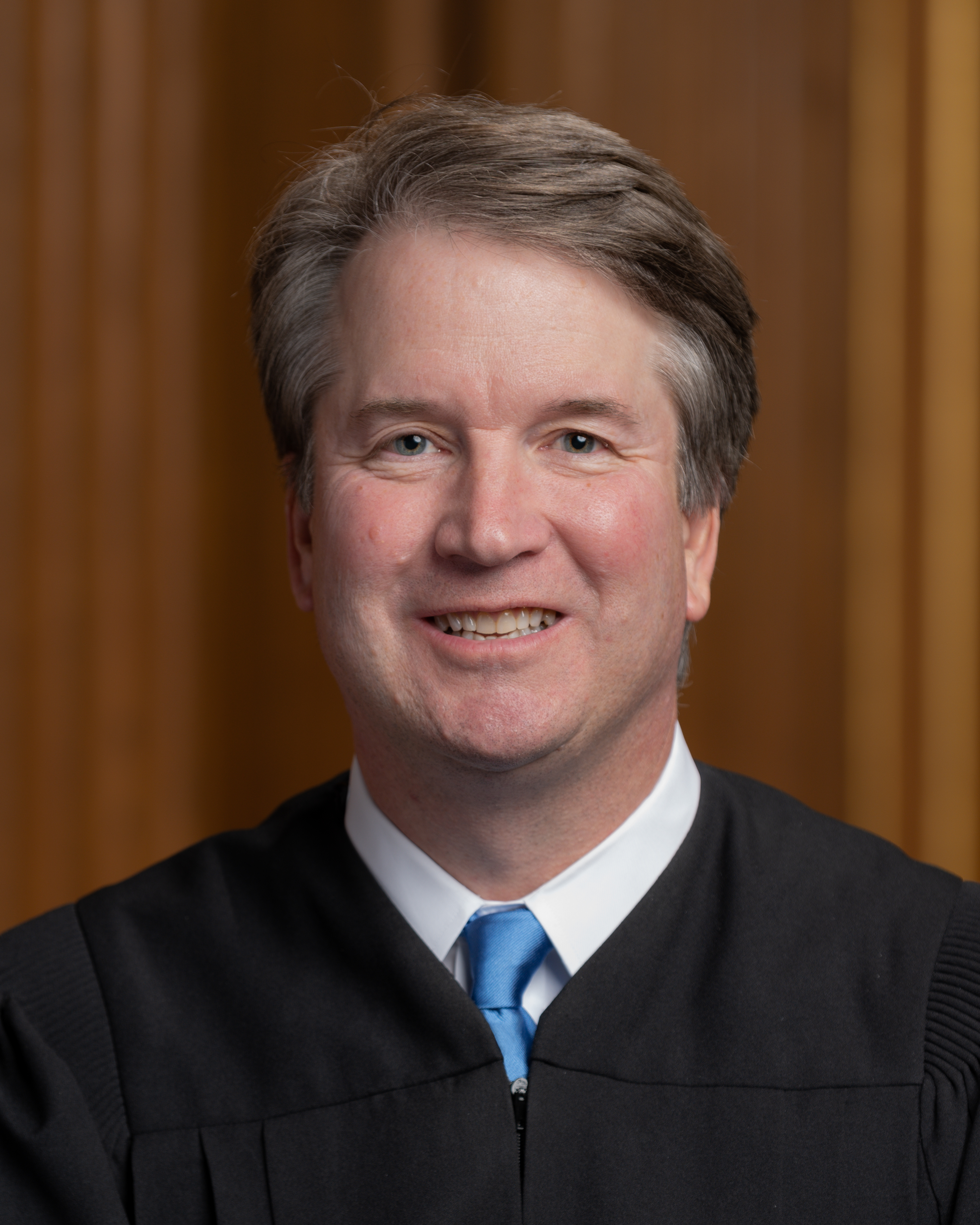
Brett Kavanaugh


Official portrait of Brett Kavanaugh wearing his judicial robe

Image Source: Fred Schilling / Collection of the Supreme Court of the United States, Public Domain, via Wikimedia Commons

What Was the Accusation?

During Brett Kavanaugh’s 2018 nomination to the U.S. Supreme Court, Christine Blasey Ford publicly alleged that Kavanaugh had sexually assaulted her when both were teenagers in the early 1980s. Ford, a psychology professor and research psychologist, said the incident occurred at a small gathering in suburban Maryland. She alleged that Kavanaugh pushed her into a bedroom, pinned her on a bed, groped her, attempted to remove her clothing, and placed his hand over her mouth when she tried to call for help. Ford said Kavanaugh’s friend Mark Judge was also in the room and that she escaped after Judge jumped onto the bed and the three fell over. Kavanaugh categorically denied Ford’s account and said he had never sexually assaulted her or anyone else.

A second public allegation came from Deborah Ramirez, who attended Yale University with Kavanaugh. Ramirez told The New Yorker that, during a dormitory party in the 1983–1984 academic year, an intoxicated Kavanaugh exposed himself to her and caused her to make unwanted contact with his penis as she pushed him away. Ramirez acknowledged gaps in her memory from the evening but said she ultimately felt confident enough in her recollection to seek an FBI investigation. Kavanaugh denied Ramirez’s allegation, describing it as false. Additional allegations emerged during the confirmation fight, including claims by Julie Swetnick. Kavanaugh denied those accusations as well, and some of the additional claims became subjects of separate disputes over corroboration and credibility.

Ford and Kavanaugh testified separately under oath before the Senate Judiciary Committee on September 27, 2018. Ford said she was certain Kavanaugh was the person who assaulted her. Kavanaugh responded with an emphatic denial and argued that the accusations and the confirmation process had caused severe damage to his reputation and family. He acknowledged that he drank beer in high school, sometimes drank too much, and had said or done things as a teenager that made him cringe in retrospect, but he rejected any connection between that behavior and the sexual-assault allegation. He also emphasized that sexual-assault allegations should be taken seriously while asserting that an accused person was entitled to be heard and afforded due process.

Kavanaugh’s response became a prominent political apologia because it went beyond a simple denial. In his prepared and oral testimony, he repeatedly rejected the misconduct allegations, described the late-emerging accusations as smears and character assassination, and defended his reputation by pointing to his personal relationships with women, his record as a judge and teacher, his family, his public service, and his support for female law clerks and students. The September 27 hearing intensified an already polarized confirmation battle. After an additional FBI background investigation, the Senate confirmed Kavanaugh as an Associate Justice of the Supreme Court on October 6, 2018, by a vote of 50–48. Ford and Ramirez continued to stand by their allegations, while Kavanaugh continued to deny sexual misconduct.

Key Apologia Strategies:

Denial, Attacking the Accuser, Bolstering

Video

Transcript

Prepared Written Testimony of Judge Brett M. Kavanaugh — September 27, 2018:

Mr. Chairman, Ranking Member Feinstein, and Members of the Committee:

Eleven days ago, Dr. Ford publicly accused me of committing a serious wrong more than 36 years ago when we were both in high school. I denied the allegation immediately, unequivocally, and categorically. The next day, I told this Committee that I wanted to testify as soon as possible, under oath, to clear my name.

Over the past few days, other false and uncorroborated accusations have been aired. There has been a frenzy to come up with something—anything, no matter how far-fetched or odious—that will block a vote on my nomination. These are last-minute smears, pure and simple. They debase our public discourse. And the consequences extend beyond any one nomination. Such grotesque and obvious character assassination—if allowed to succeed—will dissuade competent and good people of all political persuasions from serving our country.

As I told this Committee the last time I appeared before you, a federal judge must be independent, not swayed by public or political pressure. That is the kind of judge I am and will always be. I will not be intimidated into withdrawing from this process. This effort to destroy my good name will not drive me out. The vile threats of violence against my family will not drive me out. I am here this morning to answer these allegations and to tell the truth. And the truth is that I have never sexually assaulted anyone—not in high school, not in college, not ever.

Sexual assault is horrific. It is morally wrong. It is illegal. It is contrary to my religious faith. And it contradicts the core promise of this Nation that all people are created equal and entitled to be treated with dignity and respect. Allegations of sexual assault must be taken seriously. Those who make allegations deserve to be heard. The subject of allegations also deserves to be heard. Due process is a foundation of the American rule of law.

Dr. Ford’s allegation dates back more than 36 years, to a party that she says occurred during our time in high school. I spent most of my time in high school focused on academics, sports, church, and service. But I was not perfect in those days, just as I am not perfect today. I drank beer with my friends, usually on weekends. Sometimes I had too many. In retrospect, I said and did things in high school that make me cringe now. But that’s not why we are here today. What I’ve been accused of is far more serious than juvenile misbehavior. I never did anything remotely resembling what Dr. Ford describes.

The allegation of misconduct is completely inconsistent with the rest of my life. The record of my life, from my days in grade school through the present day, shows that I have always promoted the equality and dignity of women.

I categorically and unequivocally deny the allegation against me by Dr. Ford. I never had any sexual or physical encounter of any kind with Dr. Ford. I am not questioning that Dr. Ford may have been sexually assaulted by some person in some place at some time. But I have never done that to her or to anyone. I am innocent of this charge.

[Additional Testimony To Follow]

Sources

Brown, E. (2018, September 16). California professor, writer of confidential Brett Kavanaugh letter, speaks out about her allegation of sexual assault. The Washington Post. https://www.washingtonpost.com/investigations/california-professor-writer-of-confidential-brett-kavanaugh-letter-speaks-out-about-her-allegation-of-sexual-assault/2018/09/16/46982194-b846-11e8-94eb-3bd52dfe917b_story.html

Farrow, R., & Mayer, J. (2018, September 23). Senate Democrats investigate a new allegation of sexual misconduct, from Brett Kavanaugh’s college years. The New Yorker. https://www.newyorker.com/news/news-desk/senate-democrats-investigate-a-new-allegation-of-sexual-misconduct-from-the-supreme-court-nominee-brett-kavanaughs-college-years-deborah-ramirez

Ford, C. B. (2018, September 26). Written testimony of Dr. Christine Blasey Ford. U.S. Senate Committee on the Judiciary. https://www.judiciary.senate.gov/imo/media/doc/09-27-18%20Ford%20Testimony%20Updated.pdf

Kavanaugh, B. M. (2018, September 26). Prepared written testimony of Judge Brett M. Kavanaugh: Nomination hearing to serve as an Associate Justice of the Supreme Court. U.S. Senate Committee on the Judiciary. https://www.judiciary.senate.gov/imo/media/doc/09-27-18%20Kavanaugh%20Testimony.pdf

U.S. Congress, Senate, Committee on the Judiciary. (2018). Confirmation hearing on the nomination of Hon. Brett M. Kavanaugh to be an Associate Justice of the Supreme Court of the United States (S. Hrg. 115-545). U.S. Government Publishing Office. https://www.govinfo.gov/app/details/CHRG-115shrg32765/CHRG-115shrg32765/context

U.S. Senate. (2018, October 6). U.S. Senate roll call vote 115th Congress, 2nd session, vote number 223: Confirmation of Brett M. Kavanaugh. https://www.senate.gov/legislative/LIS/roll_call_votes/vote1152/vote_115_2_00223.htm

U.S. Senate Committee on the Judiciary. (2018, September 23). Dr. Blasey Ford, Judge Kavanaugh to testify Thursday. https://www.judiciary.senate.gov/press/rep/releases/dr-blasey-ford-judge-kavanaugh-to-testify-thursday

Related Apologia Cases

Readers interested in this political apologia case may also want to review: